Why Zombies? Part 3

In the final installment of my uber panel of Zombie experts, they weigh on why reviewers seem to love saying that zombies have jumped the shark.  I’m not trying to ask a leading question, but, why is that NOT true?

Zombie jumps the shark

Aaron AlperAARON ALPER: It takes a long time for a monster to jump the shark. The vampire took some two-hundred years before “Twilight” came out. Just because there is a lot going in the genre doesn’t mean there’s a degradation of meaning or quality. Plus, zombies are not prone to glamorization or beauty (although you will find something very close in our upcoming ZOMBIE NATION: NEW YORK CITY). This is the beginning of the Zombie Renaissance.

Zombie Renaissance

Brad C. HodsonBRAD C. HODSON: Reading this question I literally pictured a zombie on skies flying over a shark. That would make one hell of a movie.  When I was in middle school our favorite drink was called a “suicide.” Essentially you would mix every type of soda available at the cafeteria into some bizarre concoction not really fit for human consumption. It didn’t particularly taste great, but we were obsessed with it. That’s the zombie, in my opinion. You combine a fascination with death, the mysteries of life after we pass on, a taste for gore, fear of mobs, fear of our loved ones turning against us, and a barely restrained need for violence all in one 32-ounce decomposing cup. It’s a potent combination.
Now, that’s not to say every zombie film or book is good. This may be where the “jump the shark” stuff comes into play. Like anything popular, plenty of folks have jumped on the bandwagon with no real need or desire to try anything new, or anything of quality for that matter. But this always happens when a new trend hits, especially in horror. Look at all the bad vampire films in the nineties. Or the eighties. Or the seventies. Same thing with werewolves. And serial killers. But to say that they’ve “jumped the shark” discounts the public’s obvious interest in zombies and hampers what may be the next great piece of zombie fiction or great zombie film by slamming the whole sub-genre.

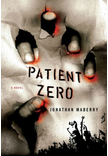
Chuck McKenzie Pontypool CHUCK MCKENZIE:  This is the sort of statement that tends to accompany any perceived ‘cult’ phenomenon that suddenly becomes extremely commercially popular, whether it be South Park, zombies, or rapping grannies, and seems to be motivated more by a desire to put back in its box something the reviewer perceives as somewhat unpleasant or  embarrassing, rather than by the facts of the Patient Zero by Jonathan Maberrymatter. Okay, rant over. Zombies aren’t even close to jumping the shark yet, because authors, illustrators, toymakers and scriptwriters haven’t yet run out of new takes on zombiedom. The last couple of years alone has given us movies as brilliant and diverse as Pontypool, Dead Snow and Zombieland, as well  as books such as S. G. Browne’s Breathers, John Ajvide Lindqvist’s Handling the Undead, and Patient Zero by whatshisname; all absolutely unique in their approach to zombies. Sure, there’s bound be a fair bit of dross along the way, but with so much *quality* product still reaching a wider-than-ever audience, it’s obvious to me that we’ve only just scratched the surface of all the zombie genre has to offer.David Dunwoody

DAVID DUNWOODY: There may be a lot of zombie media out there, but only because it’s so relevant to our time. Romero gave us a modern monster archetype that seems to speak to us more and more with every passing news cycle. The fact that the archetype is being played around with in so many different ways is wonderful. The zombie has already taken its place beside the vampire, werewolf and other classics.

The Vampire Diaries Cursed to Death by LA Banks

David Jack BellDAVID JACK BELL:  Every time something becomes popular, a bunch of people–including writers–line up to pronounce it over or overdone or dead. Instead of writing eulogies to sub-genres, why not go out and write an enduring, interesting story?
Zombies are no more dead than any other horror sub-genre. Vampires will never go away either. These are eternal, fascinating tropes. That’s why they’ve been around so long. TWILIGHT won’t kill them. Bad writing won’t kill them.

Dr PusDR. PUS:  I’m afraid this is a true statement in some instances. The horrible remakes of DAY OF THE DEAD 2: CONTAGIUM and Uwe Bolls HOUSE OF THE DEAD and the last two installments of the RETURN OF THE LIVING DEAD series have definitely “jumped the shark”. These are just terrible examples of zombie cinema. But all is not lost. Some of the new zombie movies to expand on the genre have been fantastic.  PONTYPOOL, A, REC2 (and it’s American remake QUARANTINED, DAWN OF THE DEAD  (remake) and 28 DAYS LATER (even though they’re infected and not zombies) have expanded the zombie mythos in a very positive way.  And above all else, I don’t listen to reviewers.

Eric S. Brown ERIC S. BROWN: Zombies certainly haven’t jumped the shark yet.  The genre is growing everyday with new and different takes on the zombie.  Zombie have become a pop-culture icon not just a cult monster anymore and I think they’ll be around for a while longer in the mainstream.

Fred Van Lente FRED VAN LENTE: Because nothing ever jumps the shark, so long as writers are out there trying to make new and interesting thing happen in the genre. People who provide commentary on art have two basic refrains, and that’s a.) They’ve discovered the newest/hottest/best thing before anybody else or b.) They’re the first to spot blight on the vine before those who lack their keen insight. This is why authors should pretty much ignore every single thing they say because they don’t really know anything about our profession or how to live it.

Gary Kembel GARY KEMBLE: Zombies will never be out of fashion. I can remember a few years ago, about a thousand people turned up for one of the first Brisbane Zombie Walks. There was a feeling that this zombie walk thing was heading out of fashion. Last year, more than 5,000 turned up! And similar events have been increasingly popular all over Australia (and, of course, the world).

It’s true, lately there have been zombies everywhere – games, films, books. But I think that’s more that zombies are currently part of the mainstream. Once they drop out of the mainstream, they will still be popular with the people they were popular with before they were ‘cool’.

JAKE BIBLE:  Reviewers need to get a life. Zombies haven’t jumped the shark, quite the opposite. They have finally established themselves as one of the true horror tropes. Now it’s up to creative artists to do with them as they will. Will there be horrible, clichéd zombies stories/movies/novels/comics? Yeah, just like anything out there. But, they are here to stay.

James Roy Daley JAMES ROY DALEY: Vampires jumped the shark when they stopped being monsters and became lovable, attractive teenagers. On the day zombies become loveable and attractive they’ll have jumped the shark too. But that hasn’t happened yet. Thankfully.

James Melzer JAMES MELZER: A lot of these times reviewers are just going after the mainstream stuff and yes, it is true that zombies will jump the shark there, but they’re not taking into account the hundreds of indie films or books that are made and published each year that prove zombies are still alive in the hearts of genre fans. I guess if they don’t see it on the Hollywood big screen, or see it on a bestseller list, then to them zombies are truly dead, but they couldn’t be more wrong.

JAN KOZLOWSKI JAN KOZLOWSKI: I’m not sure that it isn’t true. I was speaking to an editor a few months ago about the horror genre and while she was still excited about zombies, I told her that, IMHO, while zombies hadn’t reached the saturation level of vampires yet, they were definitely on their way. That’s the reason the story I’m working on now is tangentially related to zombies, but is really about an even more terrifying evolution.

The Evolution of Zombie Man

Jason Nagy JASON NAGY:  First of all, I cannot think of one defining “jump the shark” zombie moment.  It is true that we are being bombarded with zombie media.  But that does not translate into zombies having jumped the shark.  The sad truth, and possible reason some are saying zombies have jumped the shark, is that for every one great zombie film we see there are ten horrible ones.  But the same can be said for pretty much anything: comics, superheroes, toys, music, etc.

J L BOURNE: I guess I don’t get out much.  I didn’t get the memo on this, as I’m still writing about zombies and the end of the world.  Although zombies may see a sine curve shift in popularity as do vampires, werewolves and large Cloverleaf monsters, they never quite sink out of popularity altogether.  People still love to read about survivors and the decisions they make against an army that never rests and only wants one thing.

Joe McKinney JOE McKINNEY:  Why isn’t that true?  When was the last time you read Orwell’s 1984?  Remember Big Brother’s M.O. for controlling the populace?  They did it, and continued to do it, through language.  Change the way a culture speaks and you change the way that culture thinks.  That’s one reason why Orwell included an appendix on language at the end of the book.  Now look at how thoroughly entrenched zombies have become in our language over the last few years.  They have crossed over from mere pop culture references to accepted mainstream groupspeak.  For example, following WWII we described people in shock as having the “2000 yard "That 2000 Yard Stare" by Tom Lea stare,” after the Tom Lea painting of a Marine from the Battle of Peleliu.  But today, we’re just as likely to say “that person looks like a zombie,” or has that zombie look in his eyes.

The corporate world has now recognized zombie businesses, something the forensic mechanics of yesteryear would have lumped in with financial shell games and fishy bookkeeping.  Computer science has given us zombie terminals.  Contemporary literature has appropriated the term, as in Joyce Carol Oates’ novel Zombie and Thomas McGuane’s story “The Zombie,” just to name a few.  These works, and others, don’t mention the shambling undead hordes per se, but rely on the concept of a zombie, a person suffering from a personality lobotomy.  So, really, the term is fairly well established.  I think zombies are going to be part of the horror business for a long time to come because the concept is now so familiar.  Your question suggests that some reviewers think zombies have crested some sort of hill and that, quality-wise, it’s all downhill from here.  I don’t think that’s true.  Zombies have always enjoyed a sort of dual nature as both the harlequin and the horror.  Sometimes they get lampooned.  Sometimes they get exalted.  It goes in waves.

John R. Russo JOHN R. RUSSO: Well, because just as zombies can’t die unless shot in the head, I guess the fascination with zombies won’t die either, unless we shoot each and every zombie fan in the head.  Just kidding.  But seriously, this flesheating zombie thing has tapped into a raw atavistic dread that we all feel.  For over forty years now, NIGHT OF THE LIVING DEAD has given rise to all sorts of sequels, spinoffs, rip-offs, derivatives (not the stock market kind), and merchandising and marketing items and ploys that will probably go on as long as there are books and movies.  Just when people think the phenomenon has run its course, up pops a Night of the Living Dead fresh, new concept like 28 DAYS LATER or SHAUN OF THE DEAD.  My own screenplay, ESCAPE OF THE LIVING DEAD, goes right back to the roots of the whole thing, and audiences seem to be ready for that, judging by the fact that the comic book has spawned ten sequels already, two graphic novels, and an array of tie-in products like tee-shirts, coffee mugs, beer mugs, shot glasses, etc.

.

Kim Paffenroth, PhD KIM PAFFENROTH, PhD: They’ve been saying that since I published Gospel of the Living Dead. I guess maybe someday it might come true, but on the other hand, I don’t see it as necessary. Do vampires “jump the shark” when they turn into romantic, sparkly creatures? Well, sort of, but it doesn’t seem to limit their popularity, or stop someone from reinventing them next year as something else. So if zombies ever go “too far” then I’ll just expect them to be remodeled and reconfigured soon thereafter. I mean, if you think of fads that disappeared, it’s because they were just a one note kind of song, and once you “got” the joke or the appeal, it was over. Take a pet rock – once you laugh at it, the gimmick is over, and you really can’t reinvent it as a pet paperclip or a pet stick or whatever. Zombies have way more adaptability and appeal than that.

Lyle Perez LYLE PEREZ: I love the Happy Days reference in this question. I am a blogger and I don’t see how anyone could say this. Zombies in literature have taken some twist and turns but in no way are they being played out. If anything zombies are beginning to reach a new and fresh audience. Not everyone enjoys reading about a post-apocalyptic world run by zombies. Breathers: A Zombie’s Lament by S. G. Browne is a wonderful example. It’s not your typical zombie novel so there’s a chance it will attract a different audience which in fact is good for the genre. When I first started doing reviews I hate books that weren’t the traditional mindless, shambling zombie. I have The Rising by Brian Keene to thank. If you are a true zombie fan you can never have enough.

Nicole Amberguy NICOLE AMBERGUY: It is true and it isn’t. Zombies have had a loyal cult following for decades and got to live through the excitement of seeing them in the limelight. The mainstream market has jumped the shark – the publishers saw a new “in” and they’ve exploited it to the max. They tried too much, too fast to hang on to their “new” fans and in doing so have turned them off. I work in a bookstore and have seen the onslaught of zombie retellings of classic books and the publishing of several zombie survival/combat guides. The majority of these new zombie fans don’t want anything that Max Brooks didn’t write. I feel a little elitist saying that, but it’s true. I run into these people all of the  time. They read Max Brooks, liked him, and ask me for something similar. I go through and show them six or seven different books and they shrug and ask when he will have a new one. Don’t get me wrong, I do love Max Brooks’ books, but there are so many more that are comparable or better! I think zombies are moving back to their aforementioned cult status, with a fair amount of new followers. For those of us who have been around for a while, well, we get the enjoyment of having plenty of new material to read through and watch.

Paul Freeman PAUL FREEMAN: There is a certain amount of unimaginative zombie fiction rolling off the conveyor belt, and reviewers are apt to focus on this. However, there’s also much innovative material coming off the presses – everything from epic zombie trilogies to themed zombie anthologies. The trick for the Z-lit author is to compose a new take on zombie fiction and not to get bogged down with clichés and formulaic zombie writing.

Take for example my Robin Hood book. Critics and reviewers are constantly bracketing it with works belonging to the current monster mash-up phenomenon. This is despite the fact that the folkloric hero Robin Hood is a composite character created from myth fragments spanning several centuries. Also, since there is no definitive Robin Hood book from which I could have ‘adapted’ my story, the storyline to my novella is totally original.
The bottom line is, as long as Z-lit writers remain innovative and keep their writing fresh, there will be a market for their zombie fiction.

Robert Hood ROBERT HOOD: Only a TV show or franchise that has an over-arching narrative line can jump the shark. Zombies (in the sense that we’re talking about them) are literary objects that can be placed in a story effectively or not-so-effectively depending on the creator. There’s no single driving genre object that can make the genre leap into franchise violation. Writers interpret zombies differently instance by instance — some might be off-beam, others won’t be. The reviewers who think that “zombies” have jumped the shark presumably think that particular manifestations of the sub-genre have leapt out of the pool, become laughable and lost their zombieness. But that in no way necessitates that all subsequent uses of the zombie are therefore invalid, any more than “Twilight” has destroyed vampires. Even if someone did a “Twilight”-like re-invention of the zombie, making it a glamorous sex-symbol that shines with the romantic luminescence of decay (someone probably has, right?), that doesn’t mean the entire sub-genre has been spoiled as a result.

S.G. Browne S.G. BROWNE: Zombies are just testing the waters, seeing what they’re capable of doing.  Exploring all of their options.  Being rebellious.  It’s a natural evolution in their pop-culture existence.  As soon as zombies start sparkling in the sunlight, then they will have jumped the shark.

SCOTT  BAKER: Zombie stories are a small but major part of one of the most popular genres in fiction today – apocalyptic fiction.   Americans face the constant threat of terrorism, an uncertain economic future, environmental carnage, and no signs that things are going to get better Scott Bakerany time soon.  Zombie stories capitalize on those fears and provide an escape mechanism.  We can’t kill every terrorist, the politicians from both sides of the aisle that see us as nothing more than ATMs, and corporate executives who make millions of dollars in bonuses while trashing our economy and planet.  However, if they’re zombies, we can gun them down with impunity.

White ZombieSTEPHANIE KINCAID: Besides the fact that most zombies lack the dexterity to jump anything, there is the truth that zombie stories, both on film and on the page, are about much more than just zombies.  Loathsomely lovable as they may be, zombies—with notable exceptions, of course—are not often gifted with sparkling personalities.  Where much of the story’s interest lies is in the reactions of the characters and of society to the threat, and people and society change radically from decade to decade.  An outbreak set in 2010 sees its zombies stumbling around in a very different environment than their hungry brethren of forty or fifty years ago.  And in ten years from now, the world will have changed still more, giving zombies a whole new setting to terrorize in previously unimagined ways.

Ken Foree Che Zombie

What’s more, while zombies might seem a bit … well … dead to evolve along with the times, we know that’s not the case.  After all, before anyone ever imagined the familiar flesh-eating fiends we love to fear, Haitian lore gave the world an entirely different sort of zombie: an ordinary person killed and then revived to a semblance of life in servitude.  When you consider the fact that these original zombies were destined for work in the sugar cane fields, the debates today about whether the walking dead should or shouldn’t be able to use tools highlight just how much the perception of what makes a zombie a zombie has changed.  Zombies passé?  Never.  They’re not going anywhere.  Unless you aim for the head.

TIM LONG:  There are a lot of claims that all zombie stories are the same or are just rehashes of older stories/movies with no originality. I don’t think that is true. That’s like saying all vampire shows on television are romances that center on ancient vampires that are haunted by their past. Oh wait …

I think there is still a lot of originality in zombie. I love the funnier side like S. G. Brown’s Breathers book or Shaun of the Dead and the recent Zombies of Mass Destruction films. Both movies show traditional zombies, as in shamblers, but they are used as comedic devices. It all goes to show that creators are aware that there are a lot of zombies in media and it is forcing them to up their game.

My newest book, THE ZOMBIE WILSON DIARIES is a mixed up castaway story of a man on a deserted island with only a female zombie as his ‘Wilson’ or ‘Friday’. I like originality and I hope to keep doing new and interesting things in the genre. I. for one, look forward to the next big original idea.

TODD JEPPERSON: Reviewers seem to fit into one of three groups: First, the group that was fanatical before it was “cool” and they’re upset that zombies aren’t theirs anymore; Second, the group that really doesn’t know much about what they’re reviewing, but it’s popular, so they’ll take a stab at it; Third, the group that loves anything zombie that we can get our filthy, blood crusted mitts on.  The numbers are against those of us in group three.  Luckily, we’re pretty much blinded by our need for everything undead, and we’ll never really pay it too much attention.

Todd W. Brown TODD W. BROWN:  First, for something to “jump the shark” it has to be cool, popular, and mainstream.  The zombie has always been the Wallflower at the dance.  That said, I believe the zombie is really that cute girl or guy that turns into a knockout with a new hairstyle and the removal of glasses.

Hot Zombie Librarian The zombie still hasn’t really made it to the forefront. Sure there has been some little spikes; 28 Days Later, (which really isn’t a zombie movie) being one of the biggest to advance the call out thus far.  The zombie is actually poised for a breakout and I think that is on the immediate horizon.  World War Z has reportedly been optioned by Brad Pitt.  Word is out that The Walking Dead is going to launch on AMC (the home of Breaking Bad and Mad Men). I would say that the leading edge is coming versus having already passed us by.

Tonia Brown TONIA BROWN: As kitschy as it sounds, the living dead will never die. Folks will always read zombie books and watch zombie movies because as much as we fear it, we also have a morbid fascination with death. We flirt with death because it fills us with a sense of empowerment over that which we can’t control. What better way to get right up in the face of death than have it get up and chase after us?

Besides, the best zombie book I have read in some time, The Zombie Wilson Diaries by Timothy Long, featured a zombie shark. Granted, the main character didn’t jump said shark, but he did fight it.

Tony Faville TONY FAVILLE: I do not believe that zombies have jumped the shark at all. If anything, they are becoming more and more mainstream. And maybe that in itself is what they are referring to. No longer is it the overweight acne-riddled teenager watching a ratty old VHS copy of his favorite zombie movie in his mothers basement. Today it is entire families going to see zombie films. Trust me, I wouldn’t do it myself but I have seen people taking their 5 year old to films such as Zombieland.
Tony Schaab TONY SCHAAB: Normally when you have a genre that has reached its highest point and is currently on a downturn, there is a specific point in time or item (movie, book, etc.) one can point to as the actual apex, and I don’t think anyone can legitimately demonstrate that for zombies.  Even though the market has been saturated with a lot of “lower-quality” zombie media lately, solid, popular pieces of zombie media are still plentiful: Robert Kirkman’s “The Walking Dead” comic book is still putting out new issues every month, and has recently began production as a TV series on AMC; Max Brooks’ groundbreaking “World War Z” novel is currently in production to become a feature film; and the “Father of Zombies” himself, George Romero, is still producing new zombie movies.  I’d challenge anyone to try and say that we are not still enjoying the prime of our “Zombie Renaissance.”

.

Walter Greatshell WALTER GREATSHELL: Oh, I think it’s definitely true—there’s an Italian zombie movie where a zombie actually fights a shark!  I thought it was already true when I wrote ‘Xombies’ in 2000, which was why I made such an effort to differentiate my concepts from George Romero’s.  I would have made a lot more money if I’d just stolen his ideas—who knew?

But just because zombies are overexposed doesn’t mean they can’t be treated in a fresh and worthwhile way.  A lot of things in life are boringly repetitive, such as sports or religion, but somehow zombies are played out and NASCAR can go on forever.  It’s a sick, sick world.

Zombie Zak ZOMBIE ZAK:  Because they’re wrong!  But, they are also right (but only a little bit.)  Zombies are being used in everything and anything this season.  Mash-ups are popular again (thanks to Pride and Prejudice and Zombies, et al.)  I would say that there are a good load of tasty stories, an insidious amount of mediocre stories, and a bloody bunch of bad ones out there.  I think the “jump the shark” attitude is mostly due to the “bad” (and most likely the perception of their overwhelming quantity) – they seem to overshadow the good stories.

.

.

.

.

.


Meet our Panelists for Part 3 of WHY ZOMBIES?


Joe McKinney JOE McKINNEY is a homicide detective for the San Antonio Police Department who has been writing professionally since 2006. He is the Bram Stoker-nominated author of Dead City, Quarantined, Dodging Bullets and Dead Set. His upcoming books include Apocalypse of the Dead, The Ninth Plague, The Zombie King, Lost Girl of the Lake, and The Red Empire. As a police officer, he’s received training in disaster mitigation, forensics, and homicide investigation techniques, some of which finds its way into his stories. He lives in the Texas Hill Country north of San Antonio. Visit him at http://joemckinney.wordpress.com for news and updates.

John Russo JOHN RUSSO wants everyone to know he’s a really nice guy even though he loves to scare people. He started it by co-scripting the horror classic NIGHT OF THE LIVING DEAD. one of the greatest fright flicks of all time. He also wrote the screenplays and/or stories for MIDNIGHT, SANTA CLAWS, THE MAJORETTES, RETURN OF THE LIVING DEAD and INHUMAN. He has authored fifteen terror-suspense novels, including LIVING THINGS, THE AWAKENING, VOODOO DAWN and HELL’S CREATION. His nonfiction books, SCARE TACTICS and MAKING MOVIES, are considered bibles of independent filmmaking by film students and horror fans. With long-time friend and partner, Russ Streiner, who produced NIGHT OF THE LIVING DEAD and is chairman of the Pittsburgh Film Office, he directs a top-notch movie making program at DuBois Business College in DuBois, PA. His screenplay, ESCAPE OF THE LIVING DEAD, was made into a five-part comic book that made the Top Ten nationally, and is soon to be made into a movie that he will direct. He resides in a suburb of Pittsburgh and to his knowledge none of his neighbors are zombies, although “there is one guy around the corner who is rumored to have devoured the mailman a few years ago.”

Kim Paffenroth Kim Paffenroth is a professor of religious studies at Iona College. He is the author of Gospel of the Living Dead: George Romero’s Visions of Hell on Earth (Baylor, 2006), which won the Bram Stoker Award. Since then he’s been writing zombie fiction, including Dying to Live (Permuted, 2007), and its sequel, Dying to Live: Life Sentence (Permuted, 2008). His most recent novel, Valley of the Deadth century, where the medieval Italian poet Dante is in a life and death struggle with a zombie infestation. (Permuted, 2010), combines his theological and literary interests, taking us back to the 14

Lyle Perez LYLE PEREZ is the creator of www.UndeadintheHead.com, a website dedicated to zombie books and the authors. Lyle feels it is his responsibility to review all zombie literature presented to him. Lyle was recently offered a position at BuyZombie.com as lead book reviewer. The job was eagerly accepted and he is one step closer to his goal of bringing the zombie genre to a wider audience. Humbled by the success of Undead in the Head, Lyle decided to give writing his own zombie fiction a try. His very first zombie short story, Dement, was submitted to May December Publications for their First Time Dead anthology. Dement was accepted and is set to print early 2011. A full length zombie novel is also in works from this young writer. His love for the zombie genre is expressed in every review and in every story he writes. Expect more zombie literature and reviews from Lyle. He truly has undead in the head.

Nicole Amburgey NICOLE AMBURGEY is a long-time horror fan, bookseller, and most recently, the voice of Abbie Cadaver reviewing books for Creepshow Radio. George Romero opened up my world to zombies with Dawn of the Dead and I have never looked back. To this day, I scoop up any zombie novel or film and give them a shot! I’ve also taken part in many crawls and a Thrill the World event – both as a zombie and doing makeup for participants. Currently, my fiance and I are planning our very own zombie wedding! (Seriously ;) )

Paul A. Freeman PAUL A. FREEMAN is the author of several zombie short stories which are due to be published this year in various Library of the Living Dead anthologies. He currently works in the United Arab Emirates where he lives with his wife and three children. www.paulfreeman.weebly.com

Robert Hood has been writing horror/SF for several decades and has been referred to as “Aussie Horror’s Wicked Godfather” (Black Magazine). He has published several zombie-themed stories, including part 1 of “Moments of Dying” (Black Magazine), “In the Service of the Flesh” (Aurealis), “A Place For The Dead” (Bloodsongs), “Behind Dark Blue Eyes” (Exotic Gothic 3), “Heartless” (Aurealis) and “Wasting Matilda” (forthcoming in Zombie Apocalypse, edited by Stephen Jones for Mammoth Books). Zombies also feature in some of his award-winning film articles, most notably the multi-part “Nights of the Celluloid Dead: A History of Zombie Cinema [to 2000]” He maintains a rather extensive zombie cinema listing on his film blog Undead Backbrain: http://roberthood.net/blog/index.php/zombie-movie-listing/ and his interview with George Romero, “Master of the Living Dead” can be read here: http://roberthood.net/blog/index.php/2009/01/15/master-of-the-living-dead/. Website: www.roberthood.net

S. G. Browne S. G. BROWNE is the author of Breathers, a dark comedy about life after undeath. Think Fight ClubShaun of the Dead, only with the zombies as the good guys. “A Zombie’s Lament,” his short story upon which Breathers is based, can be found in the John Skipp edited anthology Zombies: Encounters With the Hungry Dead, while “Zombie Gigolo” will appear in the upcoming anthology The Living Dead 2, edited by John Joseph Adams. www.sgbrowne.com meets

Stephanie Kincaid is a freelance editor and writer. Some of her latest zombie tales have appeared in 23 House’s Dead Set and Living Dead Press’s Book of the Dead Volume 3, as well as at Everyday Fiction (http://www.everydayfiction.com/shes-a-biter-by-stephanie-kincaid/). More of Stephanie’s zombie fare will appear in the upcoming Moron’s Guide to the Inevitable Zombocalypse; Letters From the Dead; Through the Eyes of the Undead; and Zombidays: Festivities of the Flesheaters from Library of the Living Dead Press. The most recent zombie-intensive books she has edited are the fabulous Lucky Stiff: Memoirs of an Undead Lover by Tonia Brown (a zombie story like you’ve never read before), and The Apocalypse and Satan’s Glory Hole by Timothy W. Long and Jonathan Moon. (Yes, there are zombies at the Apocalypse. You won’t want to miss it!) Stephanie’s current pet project is a collaboration with Tonia Brown on The Velveteen Zombie, a heartwarming story of a boy and his zombie, friendship and love, and what it means to be a Real Monster.

Scott Baker SCOTT BAKER has authored several short stories, including “Rednecks Shouldn’t Play with Dead Things,” which appeared in the autumn 2008 edition of the e-zine Necrotic Tissue; “Cruise of the Living Dead,” which appeared in Living Dead Press’ Dead Worlds: Volume 3 anthology (August 2009); “Deck the Malls with Bowels of Holly,” which appeared in Living Dead Press‘ Christmas Is Dead anthology (October 2009); and “Denizens,” which appeared in Living Dead Press’ The Book of Horror anthology (March 2010). Shadowfire Press is publishing The Vampire Hunters trilogy as a series of e-books. Scott is currently putting the final touches on the last two volumes of The Vampire Hunters trilogy and is finishing his next novel on how a small band of humans/vampires strive to survive the zombie apocalypse. Blog: http://scottmbakerauthor.blogspot.com/

TIM LONG has been writing tales and stories since he could hold a crayon and has also read enough books to choke a landfill. He has a fascination with all things zombies, a predilection for hula-girl dolls, and a deep seeded need to jot words on paper and thrust them at people. Tim is the author of the horror novel Among the Living. He has sold stories to almost a dozen horror anthologies, the most recent of which are Eric S. Brown’s War Wolves and Rhiannon Frater’s Witchology: Tales From the Cauldron. Tim swears that if he is ever stuck with a zombie, no matter how attractive, he will bash in her brains. Really!

Todd Jepperson is an industrial machinist living in Orem, Ut. He is currently pursuing a degree in English and Secondary Education at Utah Valley University. Jack of all trades and master of none, his hobbies include board sports, martial arts, gardening and music. His current work has him spending entirely too much time developing cutting edge poly-crystalline diamond products for the energy industry, and not nearly enough in graphic art, cartooning, writing, and illustrating.

Todd W Brown Todd W Brown lives in Portland Oregon with his wife and 2 of our 7 children.  He writes stories about zombies and also owns May December Publications LLC where he publishes zombie anthologies and horror novels.  He has two short stories in anthologies from LDP – Daddy’s Little Girl is in Book of the Dead 3 Dead and Rotting, and Kherfin is in Dead History, a Zombie Anthology.  His novel, Zomblog is available on Amazon and Dead: The Ugly Beginning is published by May December Publications. He has two two short stories to be published in Zombology III and Zombology IV for The Library of the Living Dead Press. www.maydecemberpublications.com

Tonia Brown Tonia Brown has been a fan of zombies for more years than she cares to admit. From her erotic novella The Blooming to a plethora of zombie short stories, she can’t seem to stop writing about the darned things. Her upcoming novel Lucky Stiff: Memoirs of an Undead Lover features a zombie with an unusual appetite for sex, while her current project The Cold Beneath marries her love of steampunk and the undead. She has also undertaken a collaborative project with fellow author Stephanie Kincaid, turning a beloved children’s classic into an undead feast, the result of which has become The Velveteen Zombie.

You can find more about Tonia at her website: http://www.thebackseatwriter.com

And also on Face Book at: http://www.facebook.com/backseatwriter

Tony faville TONY FAVILLE is the first time author of Zombie novel Kings of the Dead, a project he completed last November for the National Novel Writing Month. He is currently working on his next project and has made the time to submit two different short stories to two different anthologies. Tony is a former US Navy Hospital Corpsman, former Chef, firearms enthusiast, soon to be certified NRA Instructor, huge fan of all aspects of the Zombie genre, and an Officer in his local chapter of the internationally known Zombie Squad. He is currently married and has been since 1998, and lives in the Portland area with his wife, two dogs, and a cat.

Tony Schaab Tony Schaab is a 31-year-old writer, currently living in Indianapolis with his wife, dog, and newborn daughter. In addition to having stories published in humor, horror, and sci-fi anthologies, Tony has a special affinity for zombies: he runs a zombie-centric review blog, www. TheGOREScore.com, which is in the process of being compiled for a book release, and is currently working on his first full-length fiction novel, “Zombies Can’t Dance.” In his free time, Tony works as a DJ, is Troupe Manager of the improvisational comedy troupe “IndyProv,” and volunteers at his local Humane Society. Visit Tony and read more of his work at www.TonySchaab.com.

Walter Greatshell Walter Greatshell is the author of ‘Xombies: Apocalypse Blues’ (originally published as ‘Xombies’) and its sequel, ‘Xombies: Apocalypticon’ (Penguin). He is currently at work on the third book of his Xombies series. His short story, ‘The Mexican Bus,’ will appear in the upcoming zombie anthology, ‘The Living Dead 2.’ For more about Walter Greatshell’s books and colorful illustrations, visit his website: www.waltergreatshell.com or his blog, Xombierama.

Zombie Zak Zombie Zak is an expert in the munching of brains, cookies, and bacon. Often beset by the fine art of diatribe and/or poetic eruption. A plethora of skills both mad and happy, he can be found everywhere online that you may or may not want to be. Canadian born, he has established his base of operations in the friendly city of Toronto and is expecting to continue his depredations upon the rest of the world. Both living and not so much, by the short and deadlies: Zombie Zak – Feed him, fear him, don’t leave your cookies near him. http://www.facebook.com/ZombieZak.ZZ

Aaron Alper AARON ALPER is a writer/photographer. Raised in Melbourne, Florida, Aaron migrated slightly to Eckerd College, where he graduated in 2004 with a degree in Creative Writing. After dabbling in music journalism solely so he could interview his hero Tori Amos (which he proudly did in 2004), Aaron returned to graduate school to study English Education at University of South Florida St. Petersburg. It was there that he met his fellow Zombie St. Pete editors, and quickly discovered that his eccentric obsession with horror could actually be used productively. Aaron is currently working on his Masters in English and hopes to one day interview Tori Amos again. In person.  Find him at www.zombienationpublishing.com and www.facebook.com/zombiestpete

Chuck McKenzie CHUCK MCKENZIE is an Australian author, with several zombie-related short stories to his credit, and was the braiiiiins behind the cult ‘fictional blog’, One Day at a Time: Life, the Zombie Apocalypse, and Everything, which ran daily for six months in 2008. Chuck is also a staff reviewer for HorrorScope (http://ozhorrorscope.blogspot.com/), and additionally manages a large general bookshop in Melbourne, which – due to his predilections – has gained a reputation with local horror readers as being THE place to pick up zombie-related literature. You can catch up with Chuck via Chuck McKenzie’s All-Dancing Zombie Blog, at http://chuckmck1.livejournal.com/

David Dunwoody

DAVID DUNWOODY is the author of the zombie novel Empire, of which the 2nd edition was recently released by Gallery Books and Permuted Press. His weird zombie tales have appeared in anthologies such as Zombology, History is Dead, and all four volumes of Permuted Press’ The Undead. Dave lives in Utah.  Links: http://daviddunwoody.com/
http://www.facebook.com/ddunwoody

David Jack Bell DAVID JACK BELL  is the author of two novels, including the zombie novel, THE CONDEMNED from Delirium Books. Of THE CONDEMNED, David Morrell, author of FIRST BLOOD, said, “Gave me the tingle I felt when I read Richard Matheson’s I AM LEGEND for the first time…” His short fiction is forthcoming from Cemetery Dance and Shock Totem, and he can be reached through his website www.davidjackbell.com. He is at work on a sequel to THE CONDEMNED called TOWN WATCH.  David Jack Bell  | http://www.davidjackbell.com

Eric S. Brown ERIC S. BROWN is the author of such titles as Season of Rot, War of the Worlds Plus Blood Guts and Zombies (soon to be re-released by Simon and Schuster), World War of the Dead, and numerous other zombie books.  He is a life long fan of the genre and horror in general.   Some of his non-zombie works include How the West Went to Hell (an epic demon plague story set in the old west) and Bigfoot War.  He lives in NC with his loving wife and son where he continues to write tales of blazing guns and rotting flesh.   Most of his titles may be found at www.amazon.com www.pillhillpress.com features a bibliography page for Eric S. Brown and he has a presence on www.facebook.com should like to stay in touch with his current projects.

FRED VAN LENTE is the New York Times bestselling author of three entries in the Marvel Zombies series, as well as Incredible Hercules (with Greg Pak) and the American Library Association award-winning Action Philosophers. His original graphic novel Cowboys & Aliens (co-written with Andrew Foley) is being adapted into motion picture form by Dreamworks and Universal, starring Daniel Craig. Van Lente’s other comics include Comic Book Comics, MODOK’s 11, Iron Man Legacy and Amazing Spider-Man. Learn more about him than you can possibly stand at his web site, http://www.fredvanlente.com

GARY KEMBLE:  I wrote my first zombie story, Back From the Grave, when I was nine or 10, before I even knew what zombies were. It had guns, a black TransAm and decapitations left, right and centre. My most recent effort is ‘Dead Air’ (first published in Robert N Stephenson’s Zombies, and reprinted in Brimstone Press’s Australian Dark Fantasy and Horror vol 3. I’ve written about the phenomenon for BLACK magazine (Brimstone Press) and ABC News Online. On top of that, I’ve written various film trivia articles for Articulate about zombie films: Dawn of the Dead (78 and 04), Day of the Dead, Shaun of the Dead, The Zombie Diaries. http://twitter.com/garykemble

Dead Mech by Jake Bible JAKE BIBLE is a writer living in Asheville, NC. He his the author of The World’s First Drabble Novel, DEAD MECH, which is currently being released as a serialized audiobook at jakebible.com, podiobooks.com and in the Library Of The Living Dead podcast. DEAD MECH is a high paced, ultra-violent, scifi-horror story pitting zombie hordes against futuristic giant, robotic battle machines in an Apocalyptic wasteland populated by feudalistic city/states, cults and cannibals. It asks the question: What happens when a human mech pilot dies and becomes a zombie? Dead Mechs are born! Mr. Bible has been a zombie fan for years and his most recent zombie story, “Zombie Blues”, is available in the April 2010 issue of Necrotic Tissue. For more information about DEAD MECH and to find out what a Drabble Novel is, go to http://jakebible.com. Feel free to reach out to him on Twitter (@jakebible) or his Facebook fan page (http://www.facebook.com/pages/Jake-Bibles-Wasteland/).

James Roy Daley JAMES ROY DALEY is the author of The Dead Parade and editor of the zombie series, Best New Zombie Tales. His zombie fiction can be found inside ‘History is Dead,’ as well as the upcoming anthologies, ‘The Zombiest,’ and ‘Through the Eyes of the Undead.

James Meltzer JAMES MELZER is the author of the forthcoming novel ESCAPE (March 2011 Permuted Press/Simon & Schuster), the first book in The Zombie Chronicles Trilogy. The novel can be heard for free right now on his website, where you can also find lots of other free material, as well as his interview series, UNLEASHED. http://jamesmelzer.net/

Jan Kozlowski Freelance writer JAN KOZLOWSKI fell in love with the horror genre in 1975 when the single drop of ruby blood on the engraved black cover of Stephen King’s Salem’s Lot mesmerized her into purchasing it. She began writing horror for her own amusement almost immediately, but didn’t begin publishing it until she sold her first story, Psychological Bacchanal to the EWG E-zine in 1997. Her short story, Parts is Parts, won awards in both the International Writing Competition sponsored by DarkEcho’s E-zine and Quoth the Raven’s Bad Stephen King contest. Another short story, Stuff It, was sold to an independent film producer and went into production as a movie short called Sweet Goodbyes. She is also proud to have her zombie stories included in two amazing anthologies- Show Time in Remittance Girl’s A Slip of the Lip Anthology and First Love Never Dies as part of Lori Perkins’ Hungry for Your Love: An Anthology of Zombie Romance.  For more information, stories, blogs and gooey zombie goodness, check out Jan’s websites www.jankozlowski.com, www.butshekeepsanicelawn.com, follow her on Twitter @jankozlowski or friend her on Facebook jan.kozlowski

Jason Nagy JASON NAGY:  After watching Dawn of the Dead at an early age I was smitten.  Or scarred.  I guess it depends on who you would ask.  Being only seven, that movie and the concept of zombies forever burned itself into my brain.  Dreams of zombies were common then and continued throughout my life.  My zombie contingency plan was established at a young age and I was constantly sizing up my surroundings in case of an attack.  Now, nearly 30 years later, I have combined my two favorite pastimes together: zombies and toys.  Launching the website zombiesandtoys.com in 2008, it originally began as a place where I would simply post zombie news I stumbled upon.  While that is still the root, it has become a type of network for zombie fans of all types.  In addition to news about movies, books, and games, we also feature interviews with artists, authors, toy designers and more.  We have contests every month where we give away video games, toys, books, and movies.  Our Facebook page has become a place where fans communicate and share ideas.  And, of course, we also feature The Zombie Toy Store.  There, you can find zombie toys of all types.  Plush zombies, crafts, exclusives, vinyl art zombie collectibles, vintage zombie toys, designer toys, and more can be found in The Zombie Toy Store.  No stone is left unturned in our search for new zombie toys.  Links: Facebook = http://www.facebook.com/pages/Zombies-Toys/90090645908?ref=mf
Twitter = http://twitter.com/zombiesandtoys Homepage = www.zombiesandtoys.com

J L BOURNE: Born in a small town in the rural south, J.L. Bourne balances his time as an active duty military officer with writing fiction based in a post-apocalyptic world overrun with the dead.  His cult classic first novel, Day by Day Armageddon is the Permuted Press number one best seller for 2008 and 2009.  The sequel, Day by Day Armageddon: Beyond Exile, is scheduled for release everywhere by Pocket Books on July 13, 2010. http://www.JLBourne.com

Dr PusDR. PUS – DR. MICHAEL CARL WEST, better known in the world of zombies as Dr. Pus, is a Dentist residing in West Virginia. He lives on 40 acres of wooded land on top of what he affectionately calls “Pus Mountain”. He has been married to his beautiful wife Tam for 24 years. His two daughters, who luckily get their looks from their Mom, are each in College. He also lives with three dogs, seventeen cats, two pygmy goats and a pet raccoon. When not causing pain to his patients the Doc works on his publishing company  “The Library of the Living Dead Press” and his pod cast  “The Library of the Living Dead Podcast”.

Jonathan Maberry

Jonathan Maberry is the New York Times bestselling, and two-time Bram Stoker winning author of the Joe Ledger series of Novels, Patient Zero (St. Martins Minotaur, 2009), The Dragon Factory (St. Martins Minotaur, 2010) and King of Plagues (St. Martins Minotaur, 2011); The Wolfman (Tor Books 2010); Rot & Ruin (Simon & Shuster, October 2010) and Dust & Decay (Simon & Shuster 2011).

His nonfiction works include Zombie CSU: Forensics of the Living Dead (Citadel 2008); They Bite! Endless Cravings of Supernatural Predators (Citadel 2009); The Cryptopedia: A Dictionary of the Weird, Strange, and Downright Bizarre (Citadel 2007) and Wanted Undead or Alive: Vampire Hunters and Other Kickass Enemies of Evil (Citadel 2010).

His work for Marvel Comics includes issues of The Punisher, Marvel Zombies Return, The Black Panther and Doomwar.

His short story, Family Business, is featured in Christopher Golden’s zombie anthology, The New Dead (St. Martin’s Press 2010)

  • Share/Bookmark

Why Zombies? – Part 2

When I reached out to the zombie community to ask ‘WHY ZOMBIES?’ I got so many terrific responses that I broke the blog into two parts. If you missed part one, here’s the link to Why Zombies? – Part 1. And here’s part two. It includes comments from Joe McKinney, John A. Russo (co-writer of NIGHT OF THE LIVING DEAD), Dr. Kim Paffenroth, Lyle Perez, Nicole Amburgey, Paul A. Freeman, Robert Hood, S.G. Browne, Stephanie Kincaid, Scott Baker, Tim Long, Todd Jepperson, Todd W. Brown, Tonia Brown, Tony Faville, Tony Schaab, Walter Greatshell and Zombie Zak!

Resident Evil: Zombie CopJOE McKINNEY: Why zombies? I’ve had plenty of interviewers ask me, “Why horror? Why not write police procedurals? You being a cop, wouldn’t that be a natural thing?” Well, I write horror because it is my first love. It was a horror story that gave me that first “Wow, this is cool!” feeling, and I’ve found myself gravitating back to horror ever since. But zombies…Why? Well, that first horror story, that first “Wow, this is cool!” moment, it came while watching Night of the Living Dead. I keep coming back to zombies for the same reason I keep coming back to horror. They hooked me early and didn’t let go.

Ghoul JOHN RUSSO: At first we didn’t call them zombies, we used the word “ghoul.” Technically, not every zombie is a flesheater. Ghouls are the ones who eat human flesh, usually dead flesh at that. As a kid I went to see just about every horror film, and I never thought that zombies were heavyweight fright material like vampires or werewolves. When we turned them into flesheaters, that seemed to do the trick — we struck an atavistic chord in people, an intense element of fear that probably goes back to when we were prey for wild beasts. George Romero wrote part of a story that gave rise to the screenplay for NIGHT OF THE LIVING DEAD, and I told him I really liked the story but he never said who these creatures were who were attacking Barbara. He said he didn’t know. So I said, “They seem like they could be dead people.” He said that was good, and I asked what they were after, why were they attacking? Again he said he didn’t know. So I said, “Why don’t we use my flesheating idea?” I was referring to a screenplay I had started which involved aliens coming to earth in search of human flesh. George liked that idea too, so that’s how we gave birth to the modern kind of zombie that hungers for human flesh.

KIM PAFFENROTH: For me? I think they have a perennial appeal to young males, because they’re such good targets, and also because the whole scenario of a zombie apocalypse lets us not just think about shooting them, but about planning all the various things we’d need to survive. So when I saw the original Dawn of the Dead I was hooked, since I was a teen at the time. But when I returned to them more recently, having thought about theology and human nature in the intervening years, I found a lot more to like about them as symbols, as conveying deeper meanings than just a survivalist fantasy.Fighting Zombies in Shawn of the Dead

LYLE PEREZ: Zombies have always been a big part of my teen and adult life. I was first introduced to the genre because of the Resident Evil games. I began playing them and slowly fell in love with the concept of zombies taking over the world. In my opinion Zombies are the most horrifying threat to humanity, if they were real. They never sleep, they never need to stop, and their one goal is to consume all life on earth. Other than being living dead cannibals, I feel that Freud’s concept of the uncanny plays a major factor in the terror zombies bring. For example, it is your wife but then again it isn’t your wife. The virus, the spirit, whatever it is has taken over her body. On the outside it is your wife but on the inside it is not. That I feel would be the most horrifying part about a zombie uprising but then again that fear is why I love zombies so much. The civil war was the most devastating war in US history. The thought of a family killing each other for their cause is upsetting. But having to kill your mother because she is infected and trying to eat you, is far more disturbing.

NICOLE AMBURGEY: Zombies represent the last great mystery to me. Other baddies are fun to read about – but I think zombies are the last real hold-out that have the possibility of existing or becoming a reality. You see walking metaphors every day, victims to the exposure of advertising and marketing and politics. No one wants to make decisions for themselves, they want to be controlled and told what they want and what they need. Historically, there are traces of zombies throughout Haitian voodoo culture that stem back to West Africa. There is so much about the human body that we simply do not know. For instance, in 1884, there was a Frenchman by the name of Jean Baptiste Vincent Laborde who conducted experiments on freshly severed heads. During one of his last experiments, he had dog blood pumping through it and it came as close as he ever got to restoring normal brain function. Its jaw snapped, muscles twitched, pupils contracted, and it had facial ticks – this was twenty minutes after being severed from the body! He wondered what would happen if he was able to do it before brain death set in. There were also many experiments conducted in the 50’s, 60’s, and 70’s involving transplantations on animals. During the 1970’s, a neurosurgeon named Robert While conducted experiments involving rhesus monkeys where he would cut the head off one and graft it to the neck of another. The “new” monkey would last anywhere from six hours to three days. My point being, zombies, to me, are the last unknown frontier. We don’t know the effects of everything that can be inflicted on the human body – natural or man-made. That’s what makes them the best – that’s what makes them “real.”

Robin Hood and Friar Tuck: Zombie Killers - A Canterbury Tale  by Paul A. Freeman PAUL A. FREEMAN: I came into Z-lit quite by chance. Until three years ago I was better known as a writer of crime fiction and long narrative poems (along the lines of Geoffrey Chaucer) rather than horror. Then, on the Café Doom forum, a thread was posted calling for flash fiction submissions for Coscom Entertainment’s zombie anthology, Bits of the Dead. My short story Hunger was accepted and my love affair with zombie fiction began. The following year Coscom Entertainment opened submissions for Vicious Verses and Reanimated Rhymes, an anthology of zombie poetry. My five-page narrative poem, Payback Time, caught the eye of the publisher, A. P. Fuchs, and he made me an offer I couldn’t refuse – if I wrote an 18,000-word zombie poem as a stand-alone novella, he would publish it. The rest, as they say, is history. Into existence came Robin Hood and Friar Tuck: Zombie Killers – A Canterbury Tale by Paul A. Freeman, for which Writers’ Forum magazine dubbed me ‘Poet of the Undead’.

Robert Hood: Stumbling inexorability, strong visual qualities, apocalyptic spectacle, the rapacious past made flesh. Zombies offer writers a strong context for human drama, suspense and profound horror. They are metaphorically rich and vastly entertaining. They can be adapted artistically to a wide range of tones, from deep terror to comedy.Relentless zombies coming to eat you...

S. G. BROWNE: Because they used to be us. Because I saw Night of the Living Dead on Creature Features when I was eleven and I fell in love. Because they’re relentless. Because they’re socially relevant. Because they’re tragically comical. Because a werewolf apocalypse is just ridiculous.

Mmmmmm, brains... Stephanie Kincaid: Zombies speak to one of my biggest fears. To me, there is nothing more terrifying than the threat of losing control of one’s own mind. Brain injuries and neurological disorders frighten me like nobody’s business. But zombies themselves don’t scare me, even though the threat of a zombie bite usually implies eventual loss of control and loss of self. Instead, zombies have always held a degree of fascination for me, probably because they allow me to explore that deep fear in an exaggerated way under the guise of entertainment that holds no true threat.

Zombie Wedding Cake On a more lighthearted note, there’s also the fact that sometimes zombies are just plain funny. Sure, some will argue that we laugh at zombies because the fact of death makes us uncomfortable, so we giggle to allay our discomfort. But we wouldn’t laugh at any old rotting corpse, provided it behaved itself. A dead guy lying in the ground like he’s supposed to isn’t funny. Once he gets up and starts walking around, he has the potential to be a laugh riot. Like a duck or a penguin or a platypus, a zombie is oblivious to its own intrinsic silliness. It has no idea how goofy it looks tottering about with its limbs in the wrong places or shedding vital bits at inopportune moments.

SCOTT BAKER: Zombies are the most frightening monster out there. They have no emotions of fear, and few vulnerabilities. And they’re relentless in their efforts to get at humans. Multiply that by hundreds or thousands of zombies bearing down on you, and you have the ultimate horror.

Vampires vs Zombies TIM LONG: Because vampires just aren’t dead enough. When you are dealing with the classic monsters, nothing is newer than or as popular as zombies are right now. Sure they have a long history in myth but only the last 40 years have seen them rise and lurch toward us like a tidal wave. They are everywhere, movies, books, comics, even the ad you see before a movie which tells you to turn off your cell phone. Zombies are scary because they are us. They are our neighbors, our friends and co-workers. They give us the opportunity to show how the worst in people can come out, in both survivors and the dead … and how to take an ax to their heads.

Todd Jepperson: Strangely, I started with Zombies because I was taking my art too seriously. I was getting frustrated with the direction that I was trying to go. I thought to myself that nobody could take a zombie comic seriously, and my style was born. Little did I know that it was gonna be like trying to relax on a razorblade sofa. My art has taken a turn for the better, but, I found that there are quite a few people taking zombie comics very seriously.

TODD W. BROWN: First I have to give all the credit, or, blame if you will, to George A. Romero and Tom Savini. Dawn of the Dead made a huge impression on me. I’d seen Jaws and The Exorcist, and gotten a bit of a chill. Dawn was the first film that complete engrossed me from start to finish. It was so…open to “what if” conversation.  I remember the days of actually going from mall to mall with my friends, seeking our own bastion against the inevitable rise of the zombies. I will say that I have been proudly hooked since 1978. Writing about zombies has allowed me to live out every adolescent’s dreams and nightmares.  The zombie, in my opinion, is the perfect monster.  His most effective disguise is that he is one of us.

Tonia Brown: Life is a chore, living even more so. As humans there are many nasty facets of our lives that we don’t want to deal with, so we create monsters to personify those parts of ourselves. Werewolves deal with our inner beasts, straining to get free and run wild. Vampires speak of the pitfalls of seduction and the consequences of wielding unspeakable power. But I love zombies most of all because they embody the worst of human fears; losing your identity and your humanity, the struggle to survive against overwhelming odds, and most of all facing your own mortality.

Zombies are terrifying because they take the concept of peace upon death, and slap it in the face. They are walking death. They are torture of endless existence, and an endless appetite. How terrible it would be to spend your entire life seeking sustenance and rest, only to have your corpse driven to a state of permanent hunger and tireless animation.

The very idea of it mocks everything we spend our whole life striving for.

TONY FAVILLE: That is a very good question, and I have two answers to offer. One, not only are we, as in people in our daily lives, zombies, but ultimately, the zombies are us. We get up every day, go to work for a company that doesn’t care about us as people, we come home, we eat, we go to bed, only to get up in the morning and repeat that cycle, every day for fifty to sixty years. If that does not qualify as a zombie, then I don’t know what will.

Happy Deathday

Two, there is nothing more frightening than having your wife, friend or other loved one attempt to kill you and eat your flesh, except maybe the thought of having to fight that individual in a fight to the death. Think about it, that is the person that you promised to love, honor and cherish until death do you part. Are you ready to give the head shot necessary to put them down after reanimation?

Tony Schaab: Zombies are the ultimate “unstoppable force” – they don’t care about you, they won’t rest and won’t stop until they’ve gotten to you, they are insanely hard to permanently halt, and all they want to do is cause you harm by eating you alive. Honestly, what could be scarier than that?

WALTER GREATSHELL: I just like ‘em. When I was a little kid, my mother and I lived in Hollywood, which was a much seedier place than it is now, and one night she took me to this cruddy old movie palace to see ‘Night of the Living Dead.’ That scene with the young couple being burned alive and then eaten was about the most horrible thing I had ever witnessed—for years I wasn’t sure whether I had really seen it or just dreamed it. Those sounds and images are inextricably linked to my childhood. So, for me, zombies are pure nostalgia.

ZOMBIE ZAK: Because, I hunger. No, seriously…Because they amuse me, or more accurately, people’s reactions to them amuse me. Because, “..we is them and they is us..”

Because I have plans for complete and total dominion of the planet and they are very useful tools to that end. Because I think they are a great device in commenting on both society as a whole and upon the actions and interactions of people as individuals. Zombies provide a great means by which to highlight both the good and ill of the body social and of the person as tasty units that comprise many different groups and types of groups.

********************

Meet our Panelists for Part 2 of WHY ZOMBIES?

Joe McKinney JOE McKINNEY is a homicide detective for the San Antonio Police Department who has been writing professionally since 2006. He is the Bram Stoker-nominated author of Dead City, Quarantined, Dodging Bullets and Dead Set. His upcoming books include Apocalypse of the Dead, The Ninth Plague, The Zombie King, Lost Girl of the Lake, and The Red Empire. As a police officer, he’s received training in disaster mitigation, forensics, and homicide investigation techniques, some of which finds its way into his stories. He lives in the Texas Hill Country north of San Antonio. Visit him at http://joemckinney.wordpress.com for news and updates.

John Russo JOHN RUSSO wants everyone to know he’s a really nice guy even though he loves to scare people. He started it by co-scripting the horror classic NIGHT OF THE LIVING DEAD. one of the greatest fright flicks of all time. He also wrote the screenplays and/or stories for MIDNIGHT, SANTA CLAWS, THE MAJORETTES, RETURN OF THE LIVING DEAD and INHUMAN. He has authored fifteen terror-suspense novels, including LIVING THINGS, THE AWAKENING, VOODOO DAWN and HELL’S CREATION. His nonfiction books, SCARE TACTICS and MAKING MOVIES, are considered bibles of independent filmmaking by film students and horror fans. With long-time friend and partner, Russ Streiner, who produced NIGHT OF THE LIVING DEAD and is chairman of the Pittsburgh Film Office, he directs a top-notch movie making program at DuBois Business College in DuBois, PA. His screenplay, ESCAPE OF THE LIVING DEAD, was made into a five-part comic book that made the Top Ten nationally, and is soon to be made into a movie that he will direct. He resides in a suburb of Pittsburgh and to his knowledge none of his neighbors are zombies, although “there is one guy around the corner who is rumored to have devoured the mailman a few years ago.”

Kim Paffenroth Kim Paffenroth is a professor of religious studies at Iona College. He is the author of Gospel of the Living Dead: George Romero’s Visions of Hell on Earth (Baylor, 2006), which won the Bram Stoker Award. Since then he’s been writing zombie fiction, including Dying to Live (Permuted, 2007), and its sequel, Dying to Live: Life Sentence (Permuted, 2008). His most recent novel, Valley of the Deadth century, where the medieval Italian poet Dante is in a life and death struggle with a zombie infestation. (Permuted, 2010), combines his theological and literary interests, taking us back to the 14

Lyle Perez LYLE PEREZ is the creator of www.UndeadintheHead.com, a website dedicated to zombie books and the authors. Lyle feels it is his responsibility to review all zombie literature presented to him. Lyle was recently offered a position at BuyZombie.com as lead book reviewer. The job was eagerly accepted and he is one step closer to his goal of bringing the zombie genre to a wider audience. Humbled by the success of Undead in the Head, Lyle decided to give writing his own zombie fiction a try. His very first zombie short story, Dement, was submitted to May December Publications for their First Time Dead anthology. Dement was accepted and is set to print early 2011. A full length zombie novel is also in works from this young writer. His love for the zombie genre is expressed in every review and in every story he writes. Expect more zombie literature and reviews from Lyle. He truly has undead in the head.

Nicole Amburgey NICOLE AMBURGEY is a long-time horror fan, bookseller, and most recently, the voice of Abbie Cadaver reviewing books for Creepshow Radio. George Romero opened up my world to zombies with Dawn of the Dead and I have never looked back. To this day, I scoop up any zombie novel or film and give them a shot! I’ve also taken part in many crawls and a Thrill the World event – both as a zombie and doing makeup for participants. Currently, my fiance and I are planning our very own zombie wedding! (Seriously ;) )

Paul A. Freeman PAUL A. FREEMAN is the author of several zombie short stories which are due to be published this year in various Library of the Living Dead anthologies. He currently works in the United Arab Emirates where he lives with his wife and three children. www.paulfreeman.weebly.com

Robert Hood has been writing horror/SF for several decades and has been referred to as “Aussie Horror’s Wicked Godfather” (Black Magazine). He has published several zombie-themed stories, including part 1 of “Moments of Dying” (Black Magazine), “In the Service of the Flesh” (Aurealis), “A Place For The Dead” (Bloodsongs), “Behind Dark Blue Eyes” (Exotic Gothic 3), “Heartless” (Aurealis) and “Wasting Matilda” (forthcoming in Zombie Apocalypse, edited by Stephen Jones for Mammoth Books). Zombies also feature in some of his award-winning film articles, most notably the multi-part “Nights of the Celluloid Dead: A History of Zombie Cinema [to 2000]” He maintains a rather extensive zombie cinema listing on his film blog Undead Backbrain: http://roberthood.net/blog/index.php/zombie-movie-listing/ and his interview with George Romero, “Master of the Living Dead” can be read here: http://roberthood.net/blog/index.php/2009/01/15/master-of-the-living-dead/. Website: www.roberthood.net

S. G. Browne S. G. BROWNE is the author of Breathers, a dark comedy about life after undeath. Think Fight ClubShaun of the Dead, only with the zombies as the good guys. “A Zombie’s Lament,” his short story upon which Breathers is based, can be found in the John Skipp edited anthology Zombies: Encounters With the Hungry Dead, while “Zombie Gigolo” will appear in the upcoming anthology The Living Dead 2, edited by John Joseph Adams. www.sgbrowne.com meets

Stephanie Kincaid is a freelance editor and writer. Some of her latest zombie tales have appeared in 23 House’s Dead Set and Living Dead Press’s Book of the Dead Volume 3, as well as at Everyday Fiction (http://www.everydayfiction.com/shes-a-biter-by-stephanie-kincaid/). More of Stephanie’s zombie fare will appear in the upcoming Moron’s Guide to the Inevitable Zombocalypse; Letters From the Dead; Through the Eyes of the Undead; and Zombidays: Festivities of the Flesheaters from Library of the Living Dead Press. The most recent zombie-intensive books she has edited are the fabulous Lucky Stiff: Memoirs of an Undead Lover by Tonia Brown (a zombie story like you’ve never read before), and The Apocalypse and Satan’s Glory Hole by Timothy W. Long and Jonathan Moon. (Yes, there are zombies at the Apocalypse. You won’t want to miss it!) Stephanie’s current pet project is a collaboration with Tonia Brown on The Velveteen Zombie, a heartwarming story of a boy and his zombie, friendship and love, and what it means to be a Real Monster.

Scott Baker SCOTT BAKER has authored several short stories, including “Rednecks Shouldn’t Play with Dead Things,” which appeared in the autumn 2008 edition of the e-zine Necrotic Tissue; “Cruise of the Living Dead,” which appeared in Living Dead Press’ Dead Worlds: Volume 3 anthology (August 2009); “Deck the Malls with Bowels of Holly,” which appeared in Living Dead Press‘ Christmas Is Dead anthology (October 2009); and “Denizens,” which appeared in Living Dead Press’ The Book of Horror anthology (March 2010). Shadowfire Press is publishing The Vampire Hunters trilogy as a series of e-books. Scott is currently putting the final touches on the last two volumes of The Vampire Hunters trilogy and is finishing his next novel on how a small band of humans/vampires strive to survive the zombie apocalypse. Blog: http://scottmbakerauthor.blogspot.com/

TIM LONG has been writing tales and stories since he could hold a crayon and has also read enough books to choke a landfill. He has a fascination with all things zombies, a predilection for hula-girl dolls, and a deep seeded need to jot words on paper and thrust them at people. Tim is the author of the horror novel Among the Living. He has sold stories to almost a dozen horror anthologies, the most recent of which are Eric S. Brown’s War Wolves and Rhiannon Frater’s Witchology: Tales From the Cauldron. Tim swears that if he is ever stuck with a zombie, no matter how attractive, he will bash in her brains. Really!

Todd Jepperson is an industrial machinist living in Orem, Ut. He is currently pursuing a degree in English and Secondary Education at Utah Valley University. Jack of all trades and master of none, his hobbies include board sports, martial arts, gardening and music. His current work has him spending entirely too much time developing cutting edge poly-crystalline diamond products for the energy industry, and not nearly enough in graphic art, cartooning, writing, and illustrating.

Todd W Brown Todd W Brown lives in Portland Oregon with his wife and 2 of our 7 children.  He writes stories about zombies and also owns May December Publications LLC where he publishes zombie anthologies and horror novels.  He has two short stories in anthologies from LDP – Daddy’s Little Girl is in Book of the Dead 3 Dead and Rotting, and Kherfin is in Dead History, a Zombie Anthology.  His novel, Zomblog is available on Amazon and Dead: The Ugly Beginning is published by May December Publications. He has two two short stories to be published in Zombology III and Zombology IV for The Library of the Living Dead Press. www.maydecemberpublications.com

Tonia Brown Tonia Brown has been a fan of zombies for more years than she cares to admit. From her erotic novella The Blooming to a plethora of zombie short stories, she can’t seem to stop writing about the darned things. Her upcoming novel Lucky Stiff: Memoirs of an Undead Lover features a zombie with an unusual appetite for sex, while her current project The Cold Beneath marries her love of steampunk and the undead. She has also undertaken a collaborative project with fellow author Stephanie Kincaid, turning a beloved children’s classic into an undead feast, the result of which has become The Velveteen Zombie.

You can find more about Tonia at her website: http://www.thebackseatwriter.com

And also on Face Book at: http://www.facebook.com/backseatwriter

Tony faville TONY FAVILLE is the first time author of Zombie novel Kings of the Dead, a project he completed last November for the National Novel Writing Month. He is currently working on his next project and has made the time to submit two different short stories to two different anthologies. Tony is a former US Navy Hospital Corpsman, former Chef, firearms enthusiast, soon to be certified NRA Instructor, huge fan of all aspects of the Zombie genre, and an Officer in his local chapter of the internationally known Zombie Squad. He is currently married and has been since 1998, and lives in the Portland area with his wife, two dogs, and a cat.

Tony Schaab Tony Schaab is a 31-year-old writer, currently living in Indianapolis with his wife, dog, and newborn daughter. In addition to having stories published in humor, horror, and sci-fi anthologies, Tony has a special affinity for zombies: he runs a zombie-centric review blog, www. TheGOREScore.com, which is in the process of being compiled for a book release, and is currently working on his first full-length fiction novel, “Zombies Can’t Dance.” In his free time, Tony works as a DJ, is Troupe Manager of the improvisational comedy troupe “IndyProv,” and volunteers at his local Humane Society. Visit Tony and read more of his work at www.TonySchaab.com.

Walter Greatshell Walter Greatshell is the author of ‘Xombies: Apocalypse Blues’ (originally published as ‘Xombies’) and its sequel, ‘Xombies: Apocalypticon’ (Penguin). He is currently at work on the third book of his Xombies series. His short story, ‘The Mexican Bus,’ will appear in the upcoming zombie anthology, ‘The Living Dead 2.’ For more about Walter Greatshell’s books and colorful illustrations, visit his website: www.waltergreatshell.com or his blog, Xombierama.

Zombie Zak Zombie Zak is an expert in the munching of brains, cookies, and bacon. Often beset by the fine art of diatribe and/or poetic eruption. A plethora of skills both mad and happy, he can be found everywhere online that you may or may not want to be. Canadian born, he has established his base of operations in the friendly city of Toronto and is expecting to continue his depredations upon the rest of the world. Both living and not so much, by the short and deadlies: Zombie Zak – Feed him, fear him, don’t leave your cookies near him. http://www.facebook.com/ZombieZak.ZZ

Jonathan Maberry

Jonathan Maberry is the New York Times bestselling, and two-time Bram Stoker winning author of the Joe Ledger series of Novels, Patient Zero (St. Martins Minotaur, 2009), The Dragon Factory (St. Martins Minotaur, 2010) and King of Plagues (St. Martins Minotaur, 2011); The Wolfman (Tor Books 2010); Rot & Ruin (Simon & Shuster, October 2010) and Dust & Decay (Simon & Shuster 2011).

His nonfiction works include Zombie CSU: Forensics of the Living Dead (Citadel 2008); They Bite! Endless Cravings of Supernatural Predators (Citadel 2009); The Cryptopedia: A Dictionary of the Weird, Strange, and Downright Bizarre (Citadel 2007) and Wanted Undead or Alive: Vampire Hunters and Other Kickass Enemies of Evil (Citadel 2010).

His work for Marvel Comics includes issues of The Punisher, Marvel Zombies Return, The Black Panther and Doomwar.

His short story, Family Business, is featured in Christopher Golden’s zombie anthology, The New Dead (St. Martin’s Press 2010)

  • Share/Bookmark

Father’s Day Wishes from Jonathan

Happy Father's Day from Jonathan Maberry

Click here to learn more about the Joe Ledger series chronology.

  • Share/Bookmark

Why Zombies? – Part 1

Zombies, baby! We kick off our rolling series of ZOMBIE PANEL DISCUSSIONS by addressing the fundamental question: Why zombies?

AARON ALPER:  I think I would qualify zombies as the most relevant living mythology. They’re viral and global and there is no safe place anymore. I think a lot of people can identify with those fears.

BOB FINGERMAN: Because, generally, they’re a universal problem. They’re the Bob Fingermanroach of the monster world; if you’ve seen one, you know there are thousands more where it came from. Also, they’re scary because they can’t be reasoned with. They’re worse than children. But seriously, their lack of reasoning and their pure need-driven motivation are what make them frightening. That and the fact that they’ll tear you limb from limb and devour all your soft tissue. Individually they’re just gross and unsettling, but they always come in mobs and mobs are by nature terrifying.

BRAD C. HODSON: For me zombies represent the mindless side of human nature. Whenever we watch news footage of a disaster Zombies run amoklike Katrina or the riots in LA in the nineties, it looks like we’re watching a zombie film. So in a way zombies are a way for us to deal with the fear of society run amuck.  Plus you can hack away at zombies with chainsaws and axes and it’s fun to watch. It would not be so fun if you went after a group of rioters with a bandsaw, for instance. That would just be weird and creepy.

DAVID WELLINGTON:  I grew up in Pittsburgh, PA, where George Romero made his zombie films.  They would be shown uncut in prime time on the local television stations back then so they were among the first horror movies I ever really saw.  Before I read Dracula for the first time, before I read Stephen King, I knew all about zombies.  It was only after the remake of Dawn of the Dead and 28 Days Later that I even thought I could write something about zombies myself.Night of the Living Dead

CHUCK MCKENZIE: For me personally it’s because – the glorious richness of Chuck McKenzie zombies as metaphor aside – zombies terrify me, and the things that terrify us inevitably become a source of fascination. I should clarify that it’s not so much the zombies themselves that terrify me (I don’t actually expect to meet one strolling down the street); it’s more the *idea* of what a zombie *is* – an animated corpse, generally devoid of self or intelligence, motivated only an uncontrollable hunger for human flesh. As a concept, zombies are just so wonderfully *wrong*. What’s not to fear? Or love?

ROBERT KIRKMAN:  Why not zombies?  They’re a mighty easy way to get things good and fucked up in a fictional world, and that leaves for some pretty interesting character development.  So…yeah.  Zombies. Mmmmmm. Entrails.

DAVID DUNWOODY: First, because I’m a gorehound – they’re rotting, they kill people in the most awful way, and you can pump round after round into ‘em, but they’ll just pick up their guts and keep coming.  Second, the almost-but-never-entirely-human aspect is enormously appealing. On one hand, that perceived familiarity makes them even more unsettling – and dangerous – and on the other, it’s possible to look through a zombie’s eyes for a sympathetic commentary without losing all that horrible rotting-and-guts stuff I mentioned. It ain’t easy to make a zombie sparkle.

DAVID JACK BELL:  Because they scare me. I watched NIGHT OF THE LIVING DEAD on local TV right before Halloween when I was about twelve years old. A thrilling experience. It’s human nature to be fascinated by the dead, by what happens to us after we’re dead.

ERIC S. BROWN: I have loved zombies since I was a kid.  They are the coolest way for the world to end in a sea of screams and gunfire.  Beyond that, as a writer, the zombie genre holds endless possibilities.  A zombie plague can occur anywhere or anytime from the old west to the far flung future when mankind has spread to the stars.

FRED VAN LENTE: Robert Kirkman left Marvel to work on his Image creations full time and the company asked me to take over the Marvel Zombies franchise. At first it was kind of daunting, just because I wasn’t sure where to take the title after Kirkman & Philips, but after thinking about it over a weekend the idea of turning it into a pseudo-techno-thriller starring a hard-drinking, hard-loving killer robot gunning down ravenous costumed flesh-eaters took hold, and the plot of MZ3 pretty much presented itself to me in full cloth over just a few hours. And I haven’t looked back since. Or at least much. Marvel Zombies

GARY KEMBLE: What I love about zombies is that they have a single-minded purpose – to feast on the flesh of the living. You can’t bargain with them, you can’t reason with them. All you can do is arm yourself well and pray for that all-important head shot!

JAKE BIBLE: Why not! Seriously, though, ever since I watched Night Of The Living Dead when I was ten, I have been fascinated. There is something about Death no longer being final that really grabs at that animalistic, instinctual place in my brain. For me zombies equal survival. And with survival comes a type of clarity. The BS falls away quickly and only the Truth is left.

JAMES ROY DALEY: Now there’s a question with some wiggle room. Why Zombies, huh? If you’re wondering why I happen to be drawn to the shuffling dead at this point in my life, I’m not sure I have an answer. But I might know why people are attracted to them. Now, I mean. Why people are attracted to them now. Answer is… because it’s time. Zombie walk

Zombie culture is like punk rock. Let me explain–

Back in the fifties big money, meaning Hollywood, was on a horror kick. It seemed like every third movie in production was designed to scare the pants off the viewer. Mainstream audiences lapped it up. Hollywood churned out sci-fi thrillers like The Day the Earth Stood Still (1951), The Thing from Another World (1951), Forbidden Planet (1956), and War of the Worlds (1953). They gave us monster movies like 20,000 Leagues Under the Sea (1954), Them (1954), The Blob (1958), and The Fly (1958). They coughed up mysteries like Dial M for Murder (1954) and thrillers like To Catch a Thief (1955). They gave us the classics Invasion of the Body Snatchers (1956) and Vertigo (1958). The fifties even showcased the one and only Plan 9 From Outer Space (1959). And this list of mine doesn’t even scratch the surface of what was being made. There was The Creature from the Black Lagoon, House of Wax, Dracula, Frankenstein, The Mummy, Tarantula––the list goes on and on and on. But here’s something to chew on––guess what wasn’t happening in the 1950s: the zombie film.

The Day the Earth Stood Still The Thing From Another World Forbidden Planet War of the Worlds

Okay, so… if you want to point a finger at Voodoo Island, The Zombies of Mora Tau, and a few other rarities, you do that. But zombies weren’t happening. Not Zombies in a big way. And in the sixties they still weren’t happening. Sure, a handful of films trickled through the door, like Zombies (1964), Plague of the Zombies (1966), and Cemetery of the Living Dead (1965). It should also be noted that in 1968 George Romero dropped Night of the Living ‘You Know What,’ but still… we’re looking back in time through rose colored glasses. Night of the Living Dead was an indie-film. It had a budget of The Plague of the Zombies$114,000 and had a hard time finding distribution. Big money  wasn’t thinking zombies. Nobody was. In the 1970s, nothing changed. In the 1980s, again, nothing changed. Vampire films outnumbered zombie films 100 to 1. If you want to drop names like Lucio Fulci, Brian Yuzna, Sam Raimi (and whoever else you got tucked away in your bag of zombie tricks) go ahead. Doesn’t change anything. Bottom line is this: zombie films didn’t take off like other films… and zombie literature? Forget about it. You’re reading stories from a near-empty book shelf.

I’m hearing cursing and yelling, I’m seeing fists rising and feet stomping, I’m feeling anger and resentment, and I know what you’re thinking. You’re thinking: Wait a minute, you stupid idiot! Have you somehow forgotten Dawn of the Dawn of the Dead 1978frickin’ Dead?

First of all, Dawn of the Dead was released in 1978, near the end of the greatest decade that film had ever seen. Much like Night of the Living Dead, it was a low-budget film, being created for roughly $500,000 dollars. Not to suggest the film was lost in the shuffle of life. It wasn’t. The film earned some fans and did well at the box office, but in the bigger scheme of things it was quite simply one of many successes. The biggest horror movies of the decade were Jaws (1975), which was the biggest film of all time and brought in close to a half billion dollars, Jaws 2, (1978), at 209 million dollars, and The Exorcist (1973), at 357 million dollars. With Dawn eventually taking in a respectable 55 million, it was buried by films like Star Wars (1977), Rocky (1976), and The Godfather (1972). And the films people were spending their money on in 1978 were Grease, Superman, and Animal House––in that order. Point is, there was so much going on in the 1970s that zombies were not the hot topic, nor should they have been. If we fast-forward to 1985 we can contemplate Day of the Dead, but with its budget a mere 3.5 million, and it being considerably less successful at the box office than Dawn, once again, zombies didn’t take off. Not yet.

brain New question: if the biggest, most awesomely important zombie films of all time weren’t that big, how did we get here?

Lets go back to the punk rock thing.

Sure, The Sex Pistols blew up. But in general, punk rock doesn’t ‘blow up.’ The Misfits didn’t blow up. The Ramones didn’t blow up. The Stooges didn’t blow up. They––like a fine wine––became more appreciated with age. In time, some punk bands gain an ever-expanding, hardcore following. Zombie films are like punk. They might even be punk. They gain new followers generation to generation. But there’s a flipside to gaining popularity exponentially. When enough time passes, and punk-like things become too popular, they become mainstream, which is, almost by definition, the opposite of punk. Its hard to believe that on a day like today I can walk into my local mall and buy t-shirts, stickers, and posters, for the same bands that needed to be special ordered when they were trying to get noticed. But that’s the way it is with punk. And that’s the way it is with zombies. The odds of buying a Night of the Living Dead t-shirt back in 1968 weren’t good. In fact, you couldn’t find a t-shirt no matter how hard you looked. But today? Oh yeah. Every major chain carries a whole rack of them.

Zombies are creepers. Always have been. And they’ve crept right into the mainstream. You can find them in isle three, wedged between American Idol and Harry Potter, on the same shelf as Iggy Pop and The Cramps.

Going back to the original question, why zombies?

The answer is easy: because in today’s world, zombies are mainstream. Sorry kids but its true. Enough time has passed, and that’s why they’re so popular.

Pride and Prejudice and Zombies JAMES MELZER: Zombies are extremely versatile. You can drop them in to almost any situation and make it work. The recent success of Pride and Prejudice and Zombies, as well anthologies like History is Dead from Permuted Press, show how zombies can be worked into our past, and we all know how zombies fit into the future. But again, you can drop them even into present day life and if done right, make it work for you.

JAN KOZLOWSKI: I’ve loved zombies since the first time I saw Romero’s original Night of the Living Dead at the local drive in when I was about 17. I was a pretty tough kid and I was very impressed that the BBQ scene brought me very close to throwing up, something no other movie had ever made me do. I remember thinking how cool it would be if I could make people react this strongly to my own work.

JASON NAGY:  I have had a fascination and fear of zombies ever since I was a child.  I saw Romero’s films at too young of an age and immediately fell in love with the idea of protecting myself from shambling hordes of undead.  I would sit on my porch at the age of seven late at night when all the lights in the neighborhood were out and wonder what I would do if I saw some zombies making their way down the street.

J L BOURNE: Why not?  I mean isn’t everyone afraid of the walking dead?  Does not secretly every man or woman want to be outnumbered by billions, fighting for survival against overwhelming odds?

Bring 'em on!

Check out Why Zombies? – Part 2: http://jonathanmaberry.com/why-zombies-part-2

MEET OUR ZOMBIE EXPERTS

Aaron Alper AARON ALPER is a writer/photographer. Raised in Melbourne, Florida, Aaron migrated slightly to Eckerd College, where he graduated in 2004 with a degree in Creative Writing. After dabbling in music journalism solely so he could interview his hero Tori Amos (which he proudly did in 2004), Aaron returned to graduate school to study English Education at University of South Florida St. Petersburg. It was there that he met his fellow Zombie St. Pete editors, and quickly discovered that his eccentric obsession with horror could actually be used productively. Aaron is currently working on his Masters in English and hopes to one day interview Tori Amos again. In person.  Find him at www.zombienationpublishing.com and www.facebook.com/zombiestpete


Brad C. Hodson BRAD C. HODSON’s on-again, off-again love affair with zombies began with the very first piece of fiction he ever wrote. It was terrible and he never sold it. But since then he has gone on to receive the Roselle Lewis Award for Outstanding Achievement in Short Fiction and has made the short list for the 2010 Eric Hoffer Award. His first horror novel, DARLING, will be released some time before the end of the world by Bad Moon Books. He also co-wrote and co-produced the feature film “George’s Intervention,” a zombie comedy that’s been racking up wins at film festivals all over the globe.  For more information, check out www.bradchodson.com and www.georgesintervention.com

Bob Fingerman BOB FINGERMAN is the award-winning creator of such critically acclaimed graphic novels as Beg the Question, White Like She and Recess Pieces, as well as the novel Bottomfeeder. In Bottomfeeder, Fingerman took on the vampire genre, tossing away the typical gothic and romantic trappings in favor of portraying the down to earth story of a working class Queens-bred vampire. In Recess Pieces he whipped up a bloody maelstrom of adorable moppets and the living dead set within the confines of a school. He wrote the script for Dark Horse’s Zombie World: Winter’s Dregs. His most recent graphic novel was From the Ashes, a “speculative memoir” set in the post-apocalyptic ruins of New York City. His new novel, Pariah, comes out August 2010, from Tor, and is crammed full of zombies. He also has a story in the eagerly anticipated The Living Dead 2 anthology (October 2010).

David Wellington DAVID WELLINGTON is the author of seven novels. His zombie novels “Monster Island”, “Monster Nation” and “Monster Planet”(Thunder’s Mouth Press) form a complete trilogy. He has also written a series of vampire novels including (so far) “Thirteen Bullets”, “Ninety-Nine Coffins”, “Vampire Zero” and “Twenty-Three Hours”, and in October of 2009 began his new Werewolf series, starting with “Frostbite” (all with Three Rivers Press). In 2004 he began serializing his horror fiction online, posting short chapters of a novel three times a week on a friend’s blog. Response to the project was so great that in 2004 Thunder’s Mouth Press approached Mr. Wellington about publishing “Monster Island” as a print book. His novels have been featured in Rue Morgue, Fangoria, and the New York Times. http://www.test.davidwellington.net/

Chuck McKenzie CHUCK MCKENZIE is an Australian author, with several zombie-related short stories to his credit, and was the braiiiiins behind the cult ‘fictional blog’, One Day at a Time: Life, the Zombie Apocalypse, and Everything, which ran daily for six months in 2008. Chuck is also a staff reviewer for HorrorScope (http://ozhorrorscope.blogspot.com/), and additionally manages a large general bookshop in Melbourne, which – due to his predilections – has gained a reputation with local horror readers as being THE place to pick up zombie-related literature. You can catch up with Chuck via Chuck McKenzie’s All-Dancing Zombie Blog, at http://chuckmck1.livejournal.com/

Robert Kirkman ROBERT KIRKMAN is an American comic book writer best known for his work on The Walking Dead, Invincible and Marvel Zombies. http://www.kirkmania.com/

David Dunwoody DAVID DUNWOODY is the author of the zombie novel Empire, of which the 2nd edition was recently released by Gallery Books and Permuted Press. His weird zombie tales have appeared in anthologies such as Zombology, History is Dead, and all four volumes of Permuted Press’ The Undead. Dave lives in Utah.  Links: http://daviddunwoody.com/
http://www.facebook.com/ddunwoody

David Jack Bell DAVID JACK BELL  is the author of two novels, including the zombie novel, THE CONDEMNED from Delirium Books. Of THE CONDEMNED, David Morrell, author of FIRST BLOOD, said, “Gave me the tingle I felt when I read Richard Matheson’s I AM LEGEND for the first time…” His short fiction is forthcoming from Cemetery Dance and Shock Totem, and he can be reached through his website www.davidjackbell.com. He is at work on a sequel to THE CONDEMNED called TOWN WATCH.  David Jack Bell  | http://www.davidjackbell.com

Eric S. Brown ERIC S. BROWN is the author of such titles as Season of Rot, War of the Worlds Plus Blood Guts and Zombies (soon to be re-released by Simon and Schuster), World War of the Dead, and numerous other zombie books.  He is a life long fan of the genre and horror in general.   Some of his non-zombie works include How the West Went to Hell (an epic demon plague story set in the old west) and Bigfoot War.  He lives in NC with his loving wife and son where he continues to write tales of blazing guns and rotting flesh.   Most of his titles may be found at www.amazon.com www.pillhillpress.com features a bibliography page for Eric S. Brown and he has a presence on www.facebook.com should like to stay in touch with his current projects.

FRED VAN LENTE is the New York Times bestselling author of three entries in the Marvel Zombies series, as well as Incredible Hercules (with Greg Pak) and the American Library Association award-winning Action Philosophers. His original graphic novel Cowboys & Aliens (co-written with Andrew Foley) is being adapted into motion picture form by Dreamworks and Universal, starring Daniel Craig. Van Lente’s other comics include Comic Book Comics, MODOK’s 11, Iron Man Legacy and Amazing Spider-Man. Learn more about him than you can possibly stand at his web site, http://www.fredvanlente.com

GARY KEMBLE:  I wrote my first zombie story, Back From the Grave, when I was nine or 10, before I even knew what zombies were. It had guns, a black TransAm and decapitations left, right and centre. My most recent effort is ‘Dead Air’ (first published in Robert N Stephenson’s Zombies, and reprinted in Brimstone Press’s Australian Dark Fantasy and Horror vol 3. I’ve written about the phenomenon for BLACK magazine (Brimstone Press) and ABC News Online. On top of that, I’ve written various film trivia articles for Articulate about zombie films: Dawn of the Dead (78 and 04), Day of the Dead, Shaun of the Dead, The Zombie Diaries. http://twitter.com/garykemble

Dead Mech by Jake Bible JAKE BIBLE is a writer living in Asheville, NC. He his the author of The World’s First Drabble Novel, DEAD MECH, which is currently being released as a serialized audiobook at jakebible.com, podiobooks.com and in the Library Of The Living Dead podcast. DEAD MECH is a high paced, ultra-violent, scifi-horror story pitting zombie hordes against futuristic giant, robotic battle machines in an Apocalyptic wasteland populated by feudalistic city/states, cults and cannibals. It asks the question: What happens when a human mech pilot dies and becomes a zombie? Dead Mechs are born! Mr. Bible has been a zombie fan for years and his most recent zombie story, “Zombie Blues”, is available in the April 2010 issue of Necrotic Tissue. For more information about DEAD MECH and to find out what a Drabble Novel is, go to http://jakebible.com. Feel free to reach out to him on Twitter (@jakebible) or his Facebook fan page (http://www.facebook.com/pages/Jake-Bibles-Wasteland/).

James Roy Daley JAMES ROY DALEY is the author of The Dead Parade and editor of the zombie series, Best New Zombie Tales. His zombie fiction can be found inside ‘History is Dead,’ as well as the upcoming anthologies, ‘The Zombiest,’ and ‘Through the Eyes of the Undead.’

James Meltzer JAMES MELZER is the author of the forthcoming novel ESCAPE (March 2011 Permuted Press/Simon & Schuster), the first book in The Zombie Chronicles Trilogy. The novel can be heard for free right now on his website, where you can also find lots of other free material, as well as his interview series, UNLEASHED. http://jamesmelzer.net/

Jan Kozlowski Freelance writer JAN KOZLOWSKI fell in love with the horror genre in 1975 when the single drop of ruby blood on the engraved black cover of Stephen King’s Salem’s Lot mesmerized her into purchasing it. She began writing horror for her own amusement almost immediately, but didn’t begin publishing it until she sold her first story, Psychological Bacchanal to the EWG E-zine in 1997. Her short story, Parts is Parts, won awards in both the International Writing Competition sponsored by DarkEcho’s E-zine and Quoth the Raven’s Bad Stephen King contest. Another short story, Stuff It, was sold to an independent film producer and went into production as a movie short called Sweet Goodbyes. She is also proud to have her zombie stories included in two amazing anthologies- Show Time in Remittance Girl’s A Slip of the Lip Anthology and First Love Never Dies as part of Lori Perkins’ Hungry for Your Love: An Anthology of Zombie Romance.  For more information, stories, blogs and gooey zombie goodness, check out Jan’s websites www.jankozlowski.com, www.butshekeepsanicelawn.com, follow her on Twitter @jankozlowski or friend her on Facebook jan.kozlowski

Jason Nagy JASON NAGY:  After watching Dawn of the Dead at an early age I was smitten.  Or scarred.  I guess it depends on who you would ask.  Being only seven, that movie and the concept of zombies forever burned itself into my brain.  Dreams of zombies were common then and continued throughout my life.  My zombie contingency plan was established at a young age and I was constantly sizing up my surroundings in case of an attack.  Now, nearly 30 years later, I have combined my two favorite pastimes together: zombies and toys.  Launching the website zombiesandtoys.com in 2008, it originally began as a place where I would simply post zombie news I stumbled upon.  While that is still the root, it has become a type of network for zombie fans of all types.  In addition to news about movies, books, and games, we also feature interviews with artists, authors, toy designers and more.  We have contests every month where we give away video games, toys, books, and movies.  Our Facebook page has become a place where fans communicate and share ideas.  And, of course, we also feature The Zombie Toy Store.  There, you can find zombie toys of all types.  Plush zombies, crafts, exclusives, vinyl art zombie collectibles, vintage zombie toys, designer toys, and more can be found in The Zombie Toy Store.  No stone is left unturned in our search for new zombie toys.  Links: Facebook = http://www.facebook.com/pages/Zombies-Toys/90090645908?ref=mf
Twitter = http://twitter.com/zombiesandtoys Homepage = www.zombiesandtoys.com

J L BOURNE: Born in a small town in the rural south, J.L. Bourne balances his time as an active duty military officer with writing fiction based in a post-apocalyptic world overrun with the dead.  His cult classic first novel, Day by Day Armageddon is the Permuted Press number one best seller for 2008 and 2009.  The sequel, Day by Day Armageddon: Beyond Exile, is scheduled for release everywhere by Pocket Books on July 13, 2010. http://www.JLBourne.com

Jonathan Maberry

Jonathan Maberry is the New York Times bestselling, and two-time Bram Stoker winning author of the Joe Ledger series of Novels, Patient Zero (St. Martins Minotaur, 2009), The Dragon Factory (St. Martins Minotaur, 2010) and King of Plagues (St. Martins Minotaur, 2011); The Wolfman (Tor Books 2010); Rot & Ruin (Simon & Shuster, October 2010) and Dust & Decay (Simon & Shuster 2011).

His nonfiction works include Zombie CSU: Forensics of the Living Dead (Citadel 2008); They Bite! Endless Cravings of Supernatural Predators (Citadel 2009); The Cryptopedia: A Dictionary of the Weird, Strange, and Downright Bizarre (Citadel 2007) and Wanted Undead or Alive: Vampire Hunters and Other Kickass Enemies of Evil (Citadel 2010).

His work for Marvel Comics includes issues of The Punisher, Marvel Zombies Return, The Black Panther and Doomwar.

His short story, Family Business, is featured in Christopher Golden’s zombie anthology, The New Dead (St. Martin’s Press 2010)

  • Share/Bookmark

Zombies, the Living Dead and Other Brain Eaters

Jonathan Maberry and , er... Jonathan Maberry This week I’ll kick off the first of several panel discussion blogs focusing on the buzz around pop culture’s current ‘hot monster’: Zombies.  When George Romero and John Russo wrote the script for Night of the Living Dead they thought they were making a gritty little indie horror movie that would have been about vampires had they been able to obtain the film rights to Richard Matheson’s I AM LEGEND.  What they did instead was to invent a new kind of monster.  The Living Dead.

Despite the fact that we now call these monsters ‘zombies’ –an incorrect label hung on the genre by Italian film distributors—these new monsters are the recently deceased who return to a lifelike state and who attack and consume the living.  The reason for this reanimation is only sketchily handled by Romero, which was a good call at the time because it contributed to the sheer horror of the concept.

Since the film’s 1968 release, there have been thousands of zombie movies as well as countless zombie short stories, novels, anthologies, comic books, stage shows, toys, clothing, calendars, and more.  And each year hundreds of cities around the world stage zombie crawls, zombie proms, zombie beach parties, and even zombie weddings.

The living dead are here to stay.

I’ve asked a fair number of people who are involved in zombie pop culture to answer a handful of questions about the nature of these monsters, their popularity, the genre’s strengths and weaknesses, and other topics.  Their answers are compiled into a virtual panel discussion.  Each entry will feature one question and a variety of answers.  Because so many fine folks contributed to the discussion, we’ll sometimes have multiple blog entries with the same question but different groups answering them.

The weirdness starts this week on Jonathan Maberry’s Big Scary Blog.

So…what’s my interest in tales of the hungry dead?

Rot & Ruin by Jonathan Maberry I’ve become one of those writers often referred to (with enthusiasm by fans of the genre and with incredulity by those few who still don’t ‘get it’) as a ‘zombie author. I was in the Midway Theater in 1968 when Night of the Living Dead premiered in Philadelphia.  That movie hit me hard then and I can still feel the impact. So far, my own contributions to the genre include PATIENT ZERO (St. Martins Griffin; the first in the Joe Ledger series of thrillers, in which a government ops group tackles terrorists with a zombie plagues); ZOMBIE CSU: The Forensics of the Living Dead (Citadel Press, 2008; a nonfic book that asks hundreds of experts the question: ‘How would the real world react and respond to zombies?’); the forthcoming ROT & RUIN (Simon & Schuster, Oct 2010; a teenager grows up fourteen years after the zombie apocalypse destroyed most of humanity) and its sequel, DUST & DECAY (2011); MARVEL ZOMBIES RETURN (Marvel Comics; the New York Times bestselling comic book series and graphic novel co-written by Fred Van Lente, David Wellington and Seth Grahame-Smith); and DEAD OF NIGHT (St. Martins Griffin, 2011; a standalone novel about the beginnings of an unstoppable zombie plague.  And I have three zombie short stories: “Pegleg and Paddy Save the World” (originally published in HISTORY IS DEAD edited by Kim Paffenroth for Permuted Press and reprinted in BEST NEW ZOMBIE TALES Vol 1 edited by James Roy Daley for Books of the Dead Press); “Family Business” (published in THE NEW DEAD, edited by Christopher Golden for St. Martins Griffin) and the forthcoming “Zero Tolerance” (a Joe Ledger short story in THE LIVING DEAD 2 edited by John Joseph Adams for Night Shade Books, Sept 2010).

I’ve also written about those creatures in folklore and myth that bear striking similarities to the Romero-esque flesheaters; and about the actual beliefs of the Haitian practitioners of Voduon (voodoo).   Information on these monsters appears in VAMPIRE UNIVERSE, THE CRYPTOPEDIA (co-authored by fellow Bram Stoker Award winner David F. Kramer), ZOMBIE CSU, THEY BITE (also co-authored by David F. Kramer), and the forthcoming WANTED UNDEAD OR ALIVE (co-authored by Janice Gable Bashman).

And zombielike monsters called ‘deadheads’ play a supporting role in my Pine Deep Trilogy(GHOST ROAD BLUES, DEAD MAN’S SONG and BAD MOON RISING).  So…yeah, I dig zombies.  As a writer and a lifelong fan.

Next up: The first batch of zombie experts tackles the question: “Why Zombies?” right here on the Big Scary Blog.

  • Share/Bookmark

Celebrate Military Appreciation Month with the Department of Military Sciences!

Military Appreciation Month

  • Share/Bookmark

THE JOE LEDGER Series Chronology

“Countdown” (Short story prequel to PATIENT ZERO).  Click here to download your free copy: http://us.macmillan.com/CMS400/uploadedFiles/COUNTDOWN_free.pdf

Patient Zero by Jonathan Maberry

PATIENT ZERO (St. Martins Griffin; 2009).  First novel in the series.  Joe joins the Department of Military Sciences to fight a group of terrorists with a plague that turns people into murderous zombies.  Blackstone Audio will be releasing PATIENT ZERO as an audio book later this year.

The Living Dead 2, edited by Joseph Adams

“Zero Tolerance” (Short story sequel to PATIENT ZERO).  Included in the anthology THE LIVING DEAD 2, edited by John Joseph Adams (Night Shade Books, September 2010).

“Deep, Dark” (Short story; stand-alone adventure that takes place between PATIENT ZERO and THE DRAGON FACTORY).  Click here to download your free copy: http://jonathanmaberry.com/download-the-free-joe-ledger-story-deep-dark

The Dragon Factory by Jonathan Maberry

THE DRAGON FACTORY (St. Martins Griffin, 2010).  Second Joe Ledger novel.  Joe and the DMS go up against two competing groups of geneticists.  One side is creating exotic transgenic monsters and genetically enhanced mercenary armies; the other is using 21st century technology to continue the Nazi Master Race program begun by Josef Mengele.  Both sides want to see the DMS destroyed, and they’ve drawn first blood.  Neither side is prepared for Joe Ledger as he leads Echo Team to war under a black flag.

Click here to get your DRAGON FACTORY ringtone FREE! http://www.myxer.com/ringtone:3195600/

“Cold Comfort”(Short story sequel to THE DRAGON FACTORY). This story will be posted free online in November.

THE KING OF PLAGUES (St. Martins Griffin, March 2011).  Joe and the DMS go to war against a secret society who are using weaponized versions of the Ten Plagues of Egypt as part of a terrorist campaign.

************

The Joe Ledger series has been optioned by producer Michael De Luca (Seven, Magnolia, Blade) on behalf of SONY and is in development for TV.

  • Share/Bookmark

A Conversation with New York Times Bestselling Author F. Paul Wilson

FPaulWilson by Datlow Spruill_300wJONATHAN MABERRY: For the two or three readers left in the world who may not know him, tell us about Repairman Jack.

F. PAUL WILSON: He’s an urban mercenary in Manhattan, a self-made outcast who lives in the interstices of modern society.  A ghost in our machine: no official identity, no social security number, pays no taxes.  He has a violent streak he sometimes finds hard to control.  He hires out for cash to “fix” situations that have no legal remedy.

JM:  Who hung the nickname on him?

FPW: The name Repairman Jack comes from his gunrunner pal, Abe.  Jack’s not crazy about it, but he lives with it.  He’s not a vigilante, not a do-gooder. He’s not out to right wrongs. Nor is he out to change the world or fight crime. (He’s a career criminal, after all, as are many of his friends.) He’s not Batman.   He’s just a guy with a devious mind who likes his work best when he can help what goes around come around. If you read him carefully you’ll see he gets a real jolt out of running a scam or setting up someone to be hoisted on his own petard.

JM: You’ve never allowed yourself to be shackled to one genre and yet a lot of folks that genre hopping isn’t a good idea for writers. What do you think?

FPW: Back in the old days, I never thought of it as genre-hopping.  I don’t think the term existed.  I simply wrote the next novel. I couldn’t settle into a groove of writing one kind of book. THE TOMB is nothing like THE KEEP and neither of them is like THE TOUCH and nothing in the world is like BLACK WIND. And then I did a few medical thrillers like THE SELECT and IMPLANT.

JM: I imagine that went over great with the publishing houses.

FPW: The marketing departments didn’t know what to do with me. Every time I built up a following for one type of book, I’d switch to another genre. I have a hard core of devoted readers who’ll read anything I write, but I’d lose less loyal groups, attached to certain types of fiction, when I switched.

JM: What do you think the effect of this was on your career?

FPW: I don’t know if the hopping hurt my career.  Because the medical thrillers were so different from my usual supernatural fare, I tried to do them under a different name (they’re by Colin Andrews in the UK and Europe), but my US publisher wanted someone they could send out on tour.  On the whole, though, different names for different genres lets readers know what they’re getting when they pick up a certain name.  With the way the Internet spreads information, your readers are going to know it’s one guy behind those names, and they’ll either hop with you or stay put where they’re most comfortable.

JM: Which genre do you feel is the best fit for you?

FPW: I don’t have an answer as to which is best, but I’ve found the perfect solution for myself.  I brought Repairman Jack back in 1998 with LEGACIES and the response was terrific. It was a fairly straight thriller with a science-fictiony maguffin. The next book I wanted to do was going to be different, dealing with conspiracy theories and finding the ultimate conspiracy at the heart of them all. It was going to be wild and somewhat supernatural. Here I go again: another genre hop.  Wait. Why not make it a Repairman Jack book?  Jack’s fans will gladly follow him into conspiracyville. After CONSPIRACIES came ALL THE RAGE which is at its heart a medical thriller. But with Jack there, it’s a Repairman Jack book. I’d found the solution to my genre-hopping and genre-bending and genre-blending: make Jack the protagonist.

ALL THE RAGE by F Paul Wilson_200wCONSPIRACIES by F Paul Wilson_200w

JM: You’ve been doing for a while now and established that you don’t live in a creative pigeon hole.  With Repairman Jack as the vehicle, are you free now to go where you want?

FPW: Now I can write the novels I want without worrying about leaving my readers
scratching their heads.  It’s not horror, it’s not SF, it’s not a medical thriller, it’s a Repairman Jack book. The marketing department is happy for the same reason.

JM:  But…?

FPW:   It looks like a perfect solution. Of course I’m still going to throw curves every once in a while like Sims, which was pure sf, and Midnight Mass, which is a purebred horror novel.

Secret Circles by F. Paul WilsonJM: You have a new book coming up.  What’s the lowdown on SECRET CIRCLES?

FPW: Readers want to know more about Jack than I’m willing to tell.  His last name, for instance.  Truth is, even I don’t know his last name because I’ve never given him one.  They also ask about his childhood – what sort of upbringing did he have? (The child being father to the man, and all that.)

JM: So…you’re going to start telling Repairman Jack stories for kids?  Is that something you’ve been planning to do?

FPW: Never saw myself writing for kids, especially since I already have a fair number of teen readers, mostly sixteen and up. But a motley array of forces converged to goose me into writing a novel geared toward the under-fifteen crowd.  If I’m going to write a book about Jack as a teen, why not aim it at teens (and maybe hook some new readers in the process).

JM: Is that a trend you’re following or establishing?

FPW: I’m told I’m the first author to do this – take an adult series character and do young adult novels about him.  I don’t know if it’s true.  I do know George Lucas did it with young Indy, but that was film, not prose.  Now I hear Robert Parker’s hopping on the train with young Spencer books.  Whatever.

JM: Who’s putting these books out?

FPW: I pitched the idea to Tor, they hooked me up with one of their teen editors, and gave me a contract for 3 so-called Young-Adult novels. I say “so-called” because the writing process wasn’t much different from my adult work and the style is virtually identical.  I’ve striven over the years for a clean, lean style, tailored to the pace of the thrillers I write. To my delight I found it fits a younger audience equally well. At least that’s what a focus group showed: Kids who often took up to a month to finish a book were polishing off JACK: SECRET HISTORIES over a weekend and looking for more.  So now here comes the second, JACK: SECRET CIRCLES.  The books are set in 1983 when Jack is 14.

JM:  Are you drawing on any personal experiences for the series?

FPW: I remember my own last summer before high school as a turning point in my life.  So that was where I decided to pick up Jack’s story.  Since I’d already established his birth year as 1969, I pretty much had to set the story in 1983.  Not a bad year – lots of new technology (Atari games, VCRs, and early Apple computers), disco was dead, and MTV was on the rise.

JM:  Where’s it set?

The New Jersey Pine Barrens

FPW: As luck would have it, I’d already placed Jack’s hometown in Burlington County, which juts into the mysterious and fabled Jersey Pine Barrens.  Perfect. I could work all sorts of magic in a million acres of wilderness with places no human eyes have ever seen, where strange lights jump from tree to tree, and the Jersey Devil supposedly roams.  I peopled his town with weird characters and places – like an old woman (with a dog) who’s supposedly a witch, and the town drunk who’s rumored to be able to heal with a touch but always wears gloves, and USED, the store that sells old…stuff.

JM:  I just sold a couple of Young Adult novels, too.  I expected shifting from writing for adults to writing for teens to be jarring, but I had a blast.  What about you?

FPW:  What surprised me most was how much fun I had. I delighted in peeking into Jack’s past and populating it with people who would play parts in his later life, or arranging cameos of characters from other novels.  The books practically wrote themselves. Like taking dictation.

JM:  You happy with them?

FPW: JACK: SECRET HISTORIES made a number of recommended lists and I think Jack: Secret Circles is even better.  The third, JACK: SECRET VENGEANCE tops them all.

JM:  Any chance we can get a peek?

FPW: Sure.  Here’s an excerpt from JACK: SECRET CIRCLES: http://us.macmillan.com/jacksecretcircles

JM: What’s your process from “Hey, I have an idea!” to “I just sent my manuscript to my editor!”

FPW: You know how it is – some stories come in a Eureka! moment while others result from a process of accretion.  In some I’m simply telling a story, in others I’ve got something else going on.  In The Keep I was determined from the outset to deal with different levels of evil, ranging from the human venal to the supernatural.  In The Haunted Air it was the war between reason and belief.

JM:  Are you an outline guy?

FPW:  Whatever the story, I’ve almost always outlined.  During my first 20 years as a selling writer I was a part-timer.  Every page I was turning out was precious and I couldn’t imagine getting halfway through a book and realizing I couldn’t finish it. That’s why I outlined: to avoid dead ends and blind alleys, to avert the horror of dumping hard-earned pages into the wastebasket.

JM: I meet some writers –few of them professionals—who insist that if they know how something is going to end then they lose interest.

FPW:  I want to know in advance if the story is worth telling, if it’s going to stand up to lengthy treatment, and most of all: Can I bring it to a satisfying conclusion?  That – the satisfying conclusion part – is, I believe, the best reason for an outline.  How many novels have done this to you: You’re sailing along, digging the prose and the plot and the characters when, about three-quarters of the way through, you start to notice it falling apart, finally to end not with a satisfying bang, not even with a whimper.  It doesn’t really end, it just seems . . . to . . . dribble . . . away . . .   If I’m not sure I can end a story, I don’t start it.  I feel I owe you a good ending.  Not necessarily a happy one, not necessarily a neat tying up of every loose end, but at the very least a catharsis, a release of all the narrative tension I’ve been building.  If I don’t do that, I’ve failed you.  I haven’t done my job, and you haven’t received your money’s worth.

JM: What about the organic component to storytelling?

FPW:  But I’ve never been a slave to my outlines.  I put them in a drawer and pull them out now and again when I find myself stuck.  More often than not I’ll deviate from them when an idea hits, but I always know where I’m going.  (Even in THE FIFTH HARMONIC, the only novel I’ve written without an outline, I had a pretty good idea where I was going, but only a vague idea of how I’d get there.) As the Repairman Jack series winds to an end, I’m outlining less – mostly using a list of story beats that I organize for the best dramatic effect.

JM:  Do you write straight through or rewrite as you go?

FPW:  Once I start writing, I never look back.  I reread what’s gone before only to check and incident or description for consistency.  I do no rewriting until the first draft is finished.  The reason is simple: narrative momentum.  If I keep tweaking and retweaking before I’m finished, I’ll lose the drive.  Once I’m finished, I’ve got no qualms about doing a major overhaul here and there, because I’ve got a streamlined skeleton to flesh out where needed.

JM:  Do you write chronologically?

FPW:  I start at Chapter One and go from there.  That works best for me.  I have key scenes visualized ahead of time but I like to see events unfold in sequence because I can monitor motivation and causality as I go along, and make sure each scene builds from the last and reaches for the next.  (And avoid run-on sentences like that one.)  That way I often find that what worked well in outline doesn’t hold up in fully fleshed text.  If I wrote scenes out of sequence and connected them later (as do some writers I know) I’d miss this, or find I can’t use a scene I’d spent a lot of time on.

JM:  When do you pause to get other eyes on the manuscript?

FPW:  I send my second draft out to a few beta readers I trust, consider their comments, and make changes according to the suggestions I think will make it a better book.  It’s important for beta readers to be on the same wavelength, and more important that they know they can’t anger me or hurt my feelings, no matter what they say.  Complete honesty is necessary if the process is going to work.

JM:  Most readers don’t think pros use beta readers.  They think books spring in finished form from our heads.

FPW:  People seem surprised that a guy in the racket (as F. Scott called it) this long would use beta readers.  Listen, when I start to believe that I can’t get any better, that I’ve got nothing left to learn, and that my deathless prose can’t be improved, please shoot me.

JM: Will we be seeing more of the Adversary Cycle?

FPW: Well, the Adversary Cycle ain’t what it used to be – a self-contained series of 6 interconnected novels: THE KEEP, THE TOUCH, THE TOMB, REBORN, REPRISAL, NIGHTWORLD.  The first three novels were intended as stand-alones.  Completely unrelated.  Then I went to work on a novel called THE CHADHAM CLONE.  It too was meant to be a stand alone, with no relation to anything else I’d written. I wanted it to look like a ROSEMARY’S BABY or an OMEN but be something different (just as THE KEEP looks like a vampire novel for a while, but it’s not).  I wanted to use an evil entity other than the tired old Antichrist, but who?  Then I realized I already had that entity in Rasalom from THE KEEP.  I needed a suburban setting convenient to Manhattan, and realized I already had one in Monroe where THE TOUCH took place.  I became intrigued by the challenge of tying those two novels, and THE TOMB as well, into Rasalom’s reincarnation, bringing the books full circle.   It worked so well that I suspect my subconscious might have been linking them all along.

JM:  So, this ‘happened’ rather than being the end result of a long-range plan?

FPW:  Things grew from there.  The result was an outline for a novel of 1,000 plus pages.  Nobody was going to publish that, so I broke it down into a trilogy (REBORN, REPRISAL, and NIGHTWORLD) and sold it that way.  But in my head it remains a single, generation-spanning novel.  (This was the first time, by the way, I’d ever sold anything on outline.  Until then I’d always written the book, then peddled it.)  And so the 6 books became the Adversary Cycle.  Cool.  Then I went and ruined it by writing a bunch of sequels to The Tomb and connecting all sorts of novels and stories to the Cycle until I had to absorb it into my Secret History of the World.

JM:  Is there a link where new readers can go and get some info to catch up on this?

FPW:  Yes. Go to http://repairmanjack.com/works.htm#secrethistory.  It’s the cornerstone of the Secret History, and there’ll be no seventh AC novel, but it’s now part of a bigger picture.  As for the Secret History – yeah, I’ll be adding to that.  It’s my opus vitae.

Repairman Jack

JM:  Fans tend to mythologize writers. How has that affected you over the years?

FPW: Wait a sec while I fold my cape and stow Mjollnir away with my trident and my lightning bolt.   As you know, we’ve got writers out there who think they have to wear fangs because they write vampire fiction, or wear a top hat and goggles if they write steampunk.  I spend enough time living in the world of my work in progress while I’m writing it.  I don’t need to carry it over into the real world and live my stories.  They’re not real – that’s why we call it fiction.

JM:  So, you’re okay being a normal guy.

FPW:  Pople always seem surprised by – and comment on – how “normal” I look.  But the weird stories don’t come from the haircut or the clothing, they rise from deep within, where you can’t see.   If you check my Facebook profile photos you’ll see a shot of me in a blue blazer and a collared shirt at age 10.  I haven’t changed.  I even part my hair the same.  I’m oblivious to fashion.  But after THE KEEP I met people who expected me to wear a cape.  Now that I’ve been writing Repairman Jack novels for over a decade, people expect me to be carrying a Glock, or at least an ankle-strapped backup.  I might be armed, but not in any way you’d expect.

JM:  You don’t play the part of the ‘great writer’.

FPW:  No.  The other recurring comment is how laid back I am – as if to write a bad-ass character, you’ve got to be one.  Truth is, I spew it all onto the page.  If I’m pissed, I kill a character, and then I feel better.

JM: You’ve been at this for a while. What keeps it fresh?

FPW: Fresh, shmesh.  Trying to make each book at least as good as, if not better than, the last is an ongoing challenge that keeps you sharp. I can see, however, how a series could become a chore.  I sidestepped that with Repairman Jack by deciding from the start that it would be a closed-end series – I would not run Jack into the ground.  The stories would loop out from The Tomb and end at Nightworld.  I’m just starting the 15th and last novel in the series and I’m as psyched as ever.

JM:  So, it’s still fun?  The fire is still there?

FPW: The truth is, I can’t imagine not writing.  Yes, it’s work, and it’s frustrating at times, but so is anything worth doing.  For me, writing is an obsessive-compulsive disorder.  If I won $80 million in the lottery today, you know what I’d be doing the very next morning?  Well, I’d be in a CCU recovering from the heart attack winning caused me.  But as soon as I got out, I’d be writing.

JM: Which book was the most fun to write?

FPW: Different books were fun for different reasons.  SIBS because after thinking about it for 15 years, I found the crucial final twist and it wrote itself in 62 days.  THE FIFTH HARMONIC because leaping without the safety net of an outline was exhilarating.  THE SELECT because I found writing under a pseudonym strangely liberating (and it netted me the biggest advance of my career).  And CRISSCROSS because of the elegant way the unrelated plotlines intersected and resolved each other at the end.

JM: What’s next?

FPW: Well, JACK: SECRET CIRCLES is a February 2010 release.  The third YA, Jack: Secret Vengeance is written and delivered and awaiting publication next year.  The penultimate Repairman Jack novel, FATAL ERROR, has begun the in-house copyediting process.  A signed limited edition will be forthcoming from Gauntlet Press and the trade edition will appear in the fall.  This summer I’ll have an essay on Day of the Jackal in ITW’s THRILLERS: 100 MUST READS, and a few months later, a young RJ story called “Piney Power” in FEAR: 13 STORIES OF SUSPENSE AND MYSTERY, a YA anthology.  Toward the end of the year, a lightly revised trade paperback edition of THE KEEP in the same format as THE TOUCH and REBORN last year.

JM:  Wait…you said ‘penultimate’ Repairman Jack story?  You’re wrapping the series?

FPW:  I’m starting the last Repairman Jack novel – working title: THE DARK AT THE END.

JM:  What about young Jack?

FPW:  I may start a 4th (and absolutely last) YA Jack novel and use it to spin off another YA series (contemporary and not involving Jack) that I’d love to do.

JM:  So…if not Repairman Jack, then what?

FPW:  I’m thinking of doing a few straight crime/noir novels involving Jack’s early years in NYC, showing how he met the regulars in the novels and established himself as an urban mercenary.  I’d also like to do a hard-edged fantasy series set way back in the First Age, where all the mythology of the Secret History was spawned.  (Did I happen to mention how writing is an obsessive-compulsive disorder?)

JM

Connect with F. Paul Wilson:

www.repairmanjack.com
http://repairmanjack.com/works.htm#secrethistory
http://www.facebook.com/profile.php?ref=profile&id=697081684
http://twitter.com/fpaulwilson
Jack: Secret Circles excerpt: http://us.macmillan.com/jacksecretcircles

Books are a Gift Beyond Measure

  • Share/Bookmark

Friday Night with The Wolfman in Warrington

Josh and Jonathan at Borders Books in Warrington, PA The Wolfman by Jonathan Maberry

I did a signing for The Wolfman in my own backyard last night in hopes that I might help to mobilize the masses to support my new colleagues, Anthony Hopkins, Benicio Del Toro and Emily Blunt, and to honor the 1941 originals, Lon Chaney Jr., Claude Rains, Warren William and Ralph Bellamy.

The Wolfman (2010) The Wolfman (1941)

Thanks to Josh and the always-hospitable crew at Borders in Warrington, PA, and to all my friends for your never-ending support. Josh asked me to sign 10 copies for folks who couldn’t make it last night, so you might still be able to grab one.

@DennisTafoya and @JonathanMaberry Jonathan Maberry with WANTED UNDEAD OR ALIVE (Citadel 2010)

Dennis Tafoya, author of Dope Thief, and the upcoming Wolves of Fairmount Park (St. Martin’s Minotaur June 2010) stopped by to relieve his cabin fever and give me the cool Wolfman action figure sitting with me.


  • Share/Bookmark

A Conversation with New York Times Bestselling Author, David Morrell

David Morrell and Sylvester Stallone JONATHAN MABERRY: You created John Rambo, one of the most iconic action heroes of all time.  And yet most people don’t seem to know that he was a literary character first, and it’s weird that few people who mention Rambo mention you.  Why is that?

DAVID MORRELL:  Ian Fleming somehow got it in his movie contract that the James Bond movies would have his name before the title.  That goes a long way toward identifying the author with the character.  Because Rambo dies at the end of my novel FIRST BLOOD, my agent and I didn’t anticipate a film series, so we didn’t ask for that extra use of my name.

MABERRY: Still, there’s a whole generation who don’t know that Rambo was born in a novel. 

First Blood

MORRELL:  I wouldn’t say a whole generation doesn’t know that Rambo came from a book.  The novel has been constantly in print for 38 years, and when the fourth film, called RAMBO, came out in 2008, I was surprised to find a double credit, one at the beginning next to the screenwriter’s credit and the second at the start of the credit crawl when the film ended.  Still, I know what you mean.  People watch movies more than they read, and I’m not sure they read credits.

MABERRY: Do you still get a jolt when you hear the name ‘Rambo’ so often?

MORRELL:  It’s an odd experience to be associated with one of the five most identifiable characters in the world, along with Sherlock Holmes, Tarzan, James Bond, and Harry Potter.

MABERRY: You seem to be everywhere supporting writers and writers’ organizations of all kinds.  Why is that so important to you?

MORRELL: Long ago, I heard a homily that really struck me.  “We weren’t put here to be happy.  We were put here to be useful, and that in turn will make us happy.” 

MABERRY: Wow.

MORRELL: That’s certainly the case with me.  Much of my life was spent as a teacher, first at Penn State where I received my doctorate in American literature and later at the University of Iowa where I was a professor.  I feel fulfilled when I’m helping other writers and explaining things that will take them years to learn.  It’s not something I will myself to do.  I lapse into a teacher’s mode automatically whenever the occasion arises.

MABERRY: You have a new book about to hit, THE LEAGUE OF NIGHT AND FOG.  Is that a standalone or part of a series?

Brotherhood  of the Rose by David Morrell MORRELL: That novel is the third book in a classic spy trilogy that begins with THE BROTHERHOOD OF THE ROSE and continues with THE FRATERNITY OF THE STONE.  The first two books have independent characters.  The third one, THE LEAGUE OF NIGHT AND FOG, brings those characters together in what amounts to a double sequel.  THE BROTHERHOOD OF THE ROSE was the basis of an NBC miniseries after the Super Bowl in 1989

MABERRY:  I remember.  Those two books were pretty influential as I recall.

MORRELL: The series had a major effect on the spy genre because the books were one of the first to cross the British sedentary intelligent accurate spy novel (as typified by John le Carre’s work) with the robust, dodging-bullets-in-back-alleys, but not very accurate American spy novel (as typified by Robert Ludlum). 

MABERRY: Do you have a dark and shadowy background like Ian Fleming?

MORRELL: No.  I spent a great deal of time researching espionage tradecraft.  Because of the accuracy with which I depicted the profession, I was allowed to become an honorary lifetime member of the Association for Intelligence Officers.

MABERRY: Those first two books are still in print, aren’t they?

MORRELL: Ballantine recently re-released all 3 novels in a trade paperback format.  I had the chance to revise them slightly and to write afterwords.  It was enjoyable to revisit them.

MABERRY: LEAGUE is far from your first novel.  Most writers I know settle down to a system that takes the project from “Hey, I have an idea!” to “I just sent my manuscript to my editor!”  How’s your process work?

MORRELL: I describe the full process in my writing book THE SUCCESSFUL NOVELIST.  But these are some highlights.  When I get an idea for a novel, the first thing I do is research, which I’ll say more about later. 

David Morrell by Jennifer Esperanza250w Then I write a conversation with myself in which my alternate personality prods me to investigate all the implications in the story.  Those written conversations can sometimes be as long as 20 single-spaced pages.  I prefer this method instead of writing an outline.
When I finally start the book, I try to write 5 readable pages a day.  Those pages will be revised countless times.  My goal really is just to write each set of 5 pages—because if I envision the massive task of writing an entire novel, I might get overwhelmed.  The discipline and determination that a novel requires are enormous.  To paraphrase French director Francois Truffaut (who was talking about filmmaking), writing a novel is like taking a stagecoach ride.  At the start, it’s exciting.  At the end, you’re happy to get off with your life.

MABERRY: Which is probably why so many people give up.  How many drafts do you do?

MORRELL:  I usually do 3 major drafts.  In the first, I put in everything I can think of.  In the second, I cut out too much.  In the third, I find a happy balance.

MABERRY: With THE SHIMMER, you explained some strange new territory.  How did that book come about?

MORRELL: This is my 38th year as a published author.  That’s an eternity in a profession where careers tend to last 15 or 20 years.  What happens is that an author finds something that works.  The author repeats it until readers and the author both get tired.  In contrast, my models have been people like James Stewart and Frank Sinatra, who kept evolving and had numerous stages within their careers.

MABERRY: And yet there is a commonality.

MORRELL:  Sure, in that all of my books have action and suspense, but each takes its own direction.  I’ve written outdoor action thrillers (FIRST BLOOD), an environmental thriller (THE COVENANT OF THE FLAME), a political thriller (DESPERATE MEASURES), and a couple of novels about protective agents (THE FIFTH PROFESSION and THE PROTECTOR), and even an espionage holiday thriller, THE SPY WHO CAME FOR CHRISTMAS, to give a few examples out of my 30 books.  The variation stimulates me.

David Morrell Books 

MABERRY: What about your short fiction?

MORRELL: My short stories tend to be in the dark suspense or non-supernatural horror category, so in 2005, I thought it would be fun to write a string of what I call “eerie” thrillers.  These are books that have a haunting mood but don’t have any ghosts and the like.  The first, CREEPERS, was about urban explorers—history and architecture enthusiasts who sneak into old buildings that have been sealed and abandoned for decades.  Their nickname is “creepers.”  The book dramatizes 8 terrifying hours in an abandoned hotel.  The follow-up eerie novel was SCAVENGERS, which is about a lost time capsule.  The Shimmer by David Morrell

MABERRY: So where does THE SHIMMER fit in?

MORRELL: THE SHIMMER is a fictional version of the real-life Marfa lights.  Those lights have been visible outside the small Texas town of Marfa since the area was first settled in the 1880s.  In the First World War, people thought the lights were Germans getting ready to invade from nearby Mexico.  They thought the same during the Second World War.  In 1980, there was something called “the Marfa ghost-light hunt,” in which hundreds of people used horses and vehicles to search for the origins of the lights, with a lot of chaos but no success. 

MABERRY:     I heard something about James Dean and the Marfa lights.  Do you know what that was?

MORRELL: James Dean’s last movie GIANT was filmed outside Marfa.  He was fascinated by the lights and took Elizabeth Taylor and Rock Hudson to see them, but Taylor and Hudson weren’t able to see them.  This often happens with the lights.  Two people might try to see the lights, but only one will succeed.  The next night, however, the other person might succeed while the first person isn’t able to.

MABERRY:     Weird.  How’d that influence you?

MORRELL: I decided to write a thriller in which the lights represent the way our emotional baggage colors the way we see reality.  In my fictionalized version, if you’re angry, the lights will reinforce your anger.  If you’re lonely, the lights will fill you with immense satisfaction.  If you’re a professional skeptic such as a police officer, you won’t see the lights at all.  There’s also plenty of action, of course.  As always, I won’t feel I did my job properly unless the reader feels that this is interesting new thriller territory.

MABERRY: Writers seem split as to whether they love or hate research.  What’s your take?

The Sucessful Novelist by David Morrell

MORRELL: I love doing research.  It’s one of the ways that writing novels makes me a fuller person—because I learn so much and experience so much.  Sometimes the research involves history and topics such as assuming identities or urban exploration.  Other times, it involves specific skills.  It’s well known that I throw myself into the physical stuff, living above timberline in the Wyoming mountains for 30 days and learning how to do the high-speed automobile spins that you see in films like RONIN.  The most fun I had was taking a week-long offensive-defensive driving course at the Bill Scott Raceway in West Virginia.  The most painful research occurred when I broke my collarbone in a knife-fight class that my knifemaker friend Ernest Emerson taught.  I’ve had extensive firearms training as well as SCUBA training.  For the aircraft sequences in THE SHIMMER, I earned my private pilot’s license.

MABERRY: And people say that writing is a sedentary career.  So…what’s next?

DAVID MORRELL: One big project for this year is non-fiction.  It’s called THRILLERS: 100 MUST READS.  The idea is that 100 contemporary thriller writers each contribute an essay about a classic thriller.  Hank Wagner and I are the co-editors.  We also wrote some essays.  Mine are about Geoffrey Household’s ROGUE MALE, a book that had a huge influence on me, and Agatha Christie’s AND THEN THERE WERE NONE.

MABERRY: How did that project come about?

MORRELL: This is a project for the International Thriller Writers organization, which Gayle Lynds and I co-founded.  It goes back to my earlier comments about the delight I receive from teaching.  A lot of readers and thriller writers seem to think that thrillers began with Robert Ludlum or Tom Clancy, but the genre really goes back hundreds and thousands of years.  In 1860, Wilkie Collins’s THE WOMAN IN WHITE was said to be the first “novel of sensation,” but there were plenty of thrillers before that.

MABERRY: Is it just you and Hank Wagner on the project?

MORRELL:  A ton of major authors contributed essays, too many for me to ThrillerFest Vmention for fear that I’ll forget one of them.  All of them generously donated their talents so that the book could be a fundraiser for ITW.  The book (published by Oceanview) comes out this year (2010) during ITW’s gala reader/writer conference ThrillerFest, which occurs the first full week of July in New York City.

Connect with David Morrell on Twitter @DavidMorrell

- JM

Indiebound - Think Outside the Books

  • Share/Bookmark
Wanted: Undead or Alive
Wanted Undead or Alive
Patient Zero
wins The Black Glove's 1st Annual Horrorhead Award for
Best Zombie Novel!

The Black Glove
Download COUNTDOWN.
Get a FREE copy of COUNTDOWN!
Comics
Comics
Indie Store Finder

My interview on the Middle Chamber Book Podcast:

Steve Lubetkin

Jump ahead to 22:00 and hear LOST writer, Javier Grillo-Marxuach, talk about the development of Patient Zero for ABC TV.

Javier Grillo-Marxuach
Past Blogs
Joe Ledger Series
Joe Ledger Series
Rot & Ruin
Rot & Ruin
Pine Deep Series
Pine Deep Novels